

Best Solar Batteries for Africa’s Hot Climate is the topic of the discussion today.
A solar panel generates electricity. An inverter converts it. But a battery is what determines whether you actually have power when you need it — at night, during a grid outage, or through three days of heavy cloud cover.
In Africa, battery selection is not just a technical decision. It is a financial one. Choose the wrong battery chemistry, the wrong brand, or install even a good battery incorrectly, and you will be replacing it within two to three years. In a climate where ambient temperatures routinely reach 40–50°C across much of the continent, batteries face stress that their manufacturers in cooler countries rarely anticipate.
This guide cuts through the noise. It explains the science of why heat destroys batteries, identifies the only chemistry worth using in African conditions, reviews the best brands available across the continent, and gives you practical installation and sizing guidance that works for every African climate zone — from the Sahara in the north to the Highveld in the south.
Table of Contents
1. Why Heat Is a Battery’s Worst Enemy
2. Battery Chemistry Explained: Why LiFePO4 Is the Only Choice for Africa
3. Key Battery Specifications You Must Understand
4. Best Solar Battery Brands for Africa (2026)
5. Batteries to Avoid in Hot African Climates
6. Special Considerations for North Africa
7. How to Size Your Battery Bank Correctly
8. Installation Guidelines for Hot Climates
9. Battery Costs and Long-Term Financial Analysis
10. Country-by-Country Recommendations
11. References
12. Frequently Asked Questions
Why Heat Is a Battery’s Worst Enemy
To understand why battery selection matters so much in Africa, you need to understand what heat actually does to a battery at a chemical level.
All batteries — regardless of chemistry — store energy through electrochemical reactions. Heat accelerates these reactions. That sounds useful, but it is not: accelerated chemical activity causes irreversible degradation of the battery’s internal materials. The electrolyte breaks down. Electrode materials expand and contract more aggressively with each charge cycle. The separator between the positive and negative electrodes degrades faster.
The practical consequence is captured in a principle known as the Arrhenius Rule, widely applied in battery engineering: for every 10°C increase in operating temperature above the optimal range, a battery’s lifespan is approximately halved.
This means:
| Operating Temperature | Relative Lifespan |
|———————-|——————|
| 25°C (optimal) | 100% (baseline) |
| 35°C | ~50% |
| 45°C | ~25% |
| 55°C | ~12.5% |
A battery rated for 10 years at 25°C may deliver only 2–3 years of service in an unventilated installation in Khartoum, Cairo, or Ouagadougou where ambient temperatures regularly exceed 45°C during summer months.
This is not a theoretical concern. It is the lived experience of thousands of African solar system owners who bought batteries designed for European or North American climates and found them failing years ahead of their warranted lifespan.
The solution is twofold: choose the right battery chemistry (which this guide details below), and install it correctly in a thermally managed environment (covered in Section 8).
Battery Chemistry Explained: Why LiFePO4 Is the Only Choice for Africa
Several battery chemistries are marketed for solar energy storage. In African conditions, the choice is clear. Here is why:
Lead-Acid (Flooded, AGM, and Gel)
Lead-acid technology has been used in solar installations for decades. It is familiar, widely available, and relatively inexpensive upfront. Unfortunately, it performs poorly in heat across all its variants:
Flooded lead-acid batteries lose water through electrolyte evaporation at an accelerated rate in high temperatures. This requires frequent topping up with distilled water — a maintenance burden that is impractical in many African locations — and causes permanent capacity loss when neglected.
AGM (Absorbent Glass Mat) and gel batteries are sealed and maintenance-free, but they are actually more sensitive to overcharging and heat than flooded batteries. In hot climates, they experience thermal runaway risk at lower temperatures than their rated maximums and lose capacity rapidly above 30°C.
Lead-acid batteries are typically rated for 300–500 deep discharge cycles under standard conditions. In African heat, realistic cycle life is often 200–350 cycles — translating to 1–2 years of daily cycling. Their depth of discharge is also limited: discharging below 50% of capacity causes significant damage. This means only half the rated capacity is usable.
Verdict: Not recommended for primary solar storage in African conditions. The low upfront cost is consistently outweighed by frequent replacement costs and poor heat performance.
NMC and NCA Lithium Batteries
Nickel Manganese Cobalt (NMC) and Nickel Cobalt Aluminum (NCA) lithium chemistries offer high energy density — more stored energy per kilogram of battery weight — which is why they are used in electric vehicles where weight matters. However, both chemistries have a significant weakness: thermal stability.
NMC and NCA batteries are prone to thermal runaway — a self-reinforcing heating reaction — at temperatures above approximately 60°C. In African rooftop or poorly ventilated installations, this temperature is reachable. Thermal runaway can result in fire. Several documented fire incidents involving solar battery installations in Africa have involved NMC chemistry batteries.
Verdict: Not recommended for African solar installations. The heat and fire risk in African operating conditions is not acceptable.
LiFePO4 (Lithium Iron Phosphate)
LiFePO4 is the correct chemistry for Africa, and it is not a close decision. Here is why:
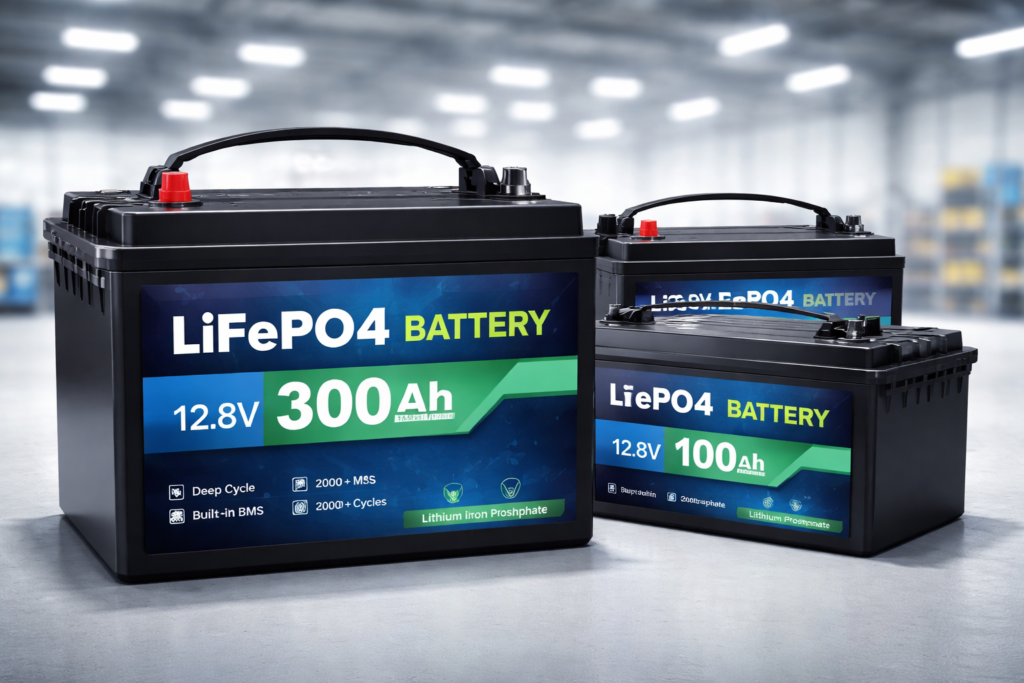
Thermal stability: LiFePO4 batteries do not experience thermal runaway until temperatures reach approximately 270°C— far beyond any realistic operating condition. Even at 60°C ambient, a quality LiFePO4 battery continues operating safely. This is the fundamental reason LiFePO4 is the right choice for Africa’s climate.
Cycle life: Quality LiFePO4 batteries are rated for 3,000–10,000 charge-discharge cycles depending on depth of discharge. At one cycle per day, this represents 8–27 years of service life. Even in demanding conditions with elevated temperatures, LiFePO4 significantly outlasts lead-acid alternatives.
Depth of discharge: LiFePO4 can be safely discharged to 80–90% of its rated capacity without significant lifespan impact. This means a 10 kWh LiFePO4 battery provides 8–9 kWh of usable energy — compared to 5 kWh from a 10 kWh lead-acid battery at 50% DoD.
Flat discharge curve: LiFePO4 maintains relatively stable voltage throughout its discharge cycle, meaning appliances receive consistent power quality right up to the point the battery is depleted. Lead-acid voltage drops progressively as the battery discharges, causing appliances to run on reduced voltage.
Verdict: The only lithium chemistry recommended for African solar storage. All batteries reviewed in this guide use LiFePO4.
Key Battery Specifications You Must Understand
Before comparing brands, understand these core specifications:
| Specification | What It Means | What to Look For |
|————–|————–|—————–|
| Capacity (kWh) | Total energy the battery can store | Match to your daily energy consumption |
| Usable capacity (kWh)| Energy available after depth-of-discharge limit | Should be 80–90% of rated capacity for LiFePO4 |
| Cycle life | Number of charge-discharge cycles at rated DoD | Minimum 3,000 cycles; 6,000+ preferred |
| Operating temp. range| Temperatures the battery functions within | Should include 50°C+ for most of Africa |
| C-rate (discharge) | Maximum continuous discharge current | Higher C-rate supports more demanding loads |
| Battery Management System (BMS) | Internal protection circuitry | Essential — must include overtemperature, overcurrent, and cell balancing protection |
| Communication protocol| How battery talks to inverter | CAN bus or RS485 for full integration |
| IP rating | Dust and moisture protection | IP55 minimum for most African installations |
| Warranty | Manufacturer’s guarantee period | Minimum 5 years; 10 years preferred |
The Battery Management System (BMS) deserves special attention. The BMS is the battery’s internal computer — it monitors cell temperature, voltage, and current in real time, and takes protective action (reducing current, shutting down) if any parameter goes out of range. A quality BMS is what separates a battery that safely handles an African summer from one that fails or becomes a fire risk.
Best Solar Battery Brands for Africa (2026)
As our way of highlighting the best solar batteries for Africa hot climates. The following brands have demonstrated reliable performance in African conditions, with verified local distribution and warranty support across key markets.
BYD Battery-Box Premium HVS/HVM — Best Overall Performance
Origin: China | Chemistry: LiFePO4 | Operating range: -10°C to 50°C
BYD (Build Your Dreams) is one of the world’s largest manufacturers of lithium batteries — the same company that produces batteries for electric vehicles at global scale. Their Battery-Box Premium series brings that industrial-grade engineering to residential and commercial solar storage.
Technical highlights:
– Modular design: start from 5.1 kWh and expand in 2.56 kWh increments up to 66 kWh (HVS) or 983 kWh (HVM at scale)
– High-voltage architecture (200–800V) reduces current and cable losses
– Passive thermal management — no fans or moving parts that can fail in dusty environments
– Integrated BMS with cell-level monitoring and balancing
– IP55 rated for dust and splash protection
Why it performs in Africa: BYD’s passive cooling design is particularly suited to Africa. Systems with cooling fans accumulate dust and require regular cleaning to avoid thermal shutdown. BYD’s fanless thermal management removes this maintenance burden while maintaining safe operating temperatures across the range of African climates.
Local support: BYD has established distributor networks and service representation in South Africa, Nigeria, Kenya, and Egypt, with presence expanding into West and East African markets.
Best for: Homeowners and businesses seeking maximum long-term reliability who have the budget for a premium investment. Particularly well-suited to North Africa and the Sahel where extreme heat is most demanding.
Typical retail price (Africa): $800 – $1,200 per 5 kWh module
Pylontech US3000C and US5000 — Best Value for Money
Origin: China | Chemistry: LiFePO4 | Operating range: -20°C to 55°C
Pylontech has earned its position as one of the most widely deployed solar battery brands across Africa through a straightforward combination of reliable performance, strong inverter compatibility, and accessible pricing. They are the benchmark against which most other value-tier batteries are compared.
Technical highlights:
– US3000C: 3.5 kWh per unit | US5000: 4.8 kWh per unit
– Up to 16 units stackable in parallel (56 kWh / 76.8 kWh respectively)
– CAN bus and RS485 communication — compatible with virtually every major inverter brand (Victron, Deye, Growatt, SMA, Sunsynk, GoodWe, and others)
– 6,000 cycle life at 80% DoD
– Strong BMS with active cell balancing and multi-level protection
Why it performs in Africa: The 55°C upper operating temperature covers the full range of African ambient conditions including North Africa in peak summer. The broad inverter compatibility makes Pylontech the most flexible choice for mixed or existing systems.
Local support: Pylontech has among the strongest distributor networks in Africa, with established channels in South Africa, Nigeria, Kenya, Ghana, Zambia, Zimbabwe, and Tanzania.
Best for: Most residential and small commercial installations across Africa. The US5000 is the better long-term value due to its higher capacity per unit and lower cost per kWh. Ideal for buyers who want proven technology at a fair price.
Typical retail price (Africa): $500 – $750 per unit (US3000C); $650 – $950 per unit (US5000)
Hubble Lithium AM Series — Best for South Africa
Origin:South Africa | Chemistry: LiFePO4 | Operating range: -20°C to 60°C
Hubble is the only major solar battery brand manufactured in South Africa, and that origin matters practically — not just symbolically. Hubble batteries are designed, tested, and warranted with explicit awareness of South African and sub-Saharan African operating conditions. Local manufacturing means local spare parts, local technical support, and warranty claims handled in days rather than months.
Technical highlights:
– AM-2: 5.5 kWh | AM-5: 11 kWh
– 100A continuous discharge current — sufficient for high-draw loads including large refrigerators, washing machines, and workshop equipment
– Aluminium alloy casing with natural heat dissipation — no fans required
– Automatic thermal protection: current reduction at 55°C, safe shutdown at 60°C
– 15-year design life warranty (longest in the South African market)
– CAN bus communication with Sunsynk, Deye, Victron, and other leading brands
Why it performs in Africa: Hubble’s thermal protection architecture is calibrated for African conditions specifically. The automatic derating at 55°C — before reaching dangerous temperatures — is a practical safety feature for installations in regions that push against upper operating limits.
Local support: Outstanding in South Africa. Hubble has a national service network with same-country warranty resolution. Expanding distribution into Nigeria and Kenya.
Best for: South African homeowners and businesses who prioritise local support and the confidence of a locally manufactured product. Also relevant for any installation in Southern Africa where rapid warranty support is valued.
Typical retail price (South Africa): R 18,000 – R 28,000 per unit depending on model (~$950 – $1,500)
Read: Best Solar Inverters for Africa: Complete Buying Guide (2026)
Dyness PowerBox B51100 — Best Budget LiFePO4 Option
Origin: China | Chemistry: LiFePO4 | Operating range: -20°C to 55°C
Dyness occupies an important space in the African market: quality LiFePO4 chemistry at a price point accessible to buyers who cannot yet stretch to Pylontech or BYD. For buyers who understand the chemistry advantage of LiFePO4 but face budget constraints, Dyness represents a meaningful step up from lead-acid without the premium pricing of top-tier brands. That’s why it made the cut for the best solar battery for Africa’s hot climate.
Technical highlights:
– BX51100: 5.12 kWh per unit
– Up to 15 units in parallel (76.8 kWh maximum)
– 6,000+ cycle life at 80% DoD
– Optional Bluetooth monitoring for real-time temperature, voltage, and state-of-charge visibility from a smartphone
– Compatible with major inverter brands via RS485 communication
Why it performs in Africa: The 55°C operating maximum covers most African installation conditions adequately. The Bluetooth monitoring feature is particularly valuable in Africa — the ability to detect developing problems (rising temperatures, unusual voltage behaviour) before they become failures allows preventative action that extends battery life significantly.
Local support: Growing distributor presence in Nigeria, Kenya, and Ghana. Support infrastructure is less developed than Pylontech but improving. Verify local service capability before purchase.
Best for: Budget-conscious buyers who understand the importance of LiFePO4 chemistry and want a meaningful quality step above lead-acid. Most appropriate for lower-demand residential installations.
Typical retail price (Africa): $450 – $650 per unit
Sunsynk Battery — Best Integration with Sunsynk Inverters
Origin: South Africa / UK | Chemistry: LiFePO4 | Operating range: -20°C to 55°C
Sunsynk batteries are engineered to work as an integrated system with Sunsynk inverters — Africa’s most widely deployed hybrid inverter brand in the South African market. The value proposition is seamless integration: inverter and battery communicate directly, enabling optimised charge management, real-time monitoring through a single interface, and simplified troubleshooting.
Technical highlights:
– 5.32 kWh per unit, stackable to larger systems
– Deep integration with Sunsynk inverter ecosystem
– Strong BMS with full protection suite
– Monitored through Sunsynk’s SolarmanPV platform
Why it performs in Africa: If you have already chosen a Sunsynk inverter — or are specifying one — the Sunsynk battery removes all compatibility uncertainty and delivers a fully optimised, factory-matched system. In markets where technical support calls often stem from inverter-battery communication issues, this integration advantage has real operational value.
Local support: Strong in South Africa through the Sunsynk distribution network. Growing presence across sub-Saharan Africa.
Best for: Buyers using or planning to use Sunsynk inverters who want the simplicity and performance of a fully integrated system.
Quick Comparison of Recommended Brands
| Brand | Capacity per Unit | Temp. Range | Cycle Life | Best For | Relative Price |
| BYD Premium | 5.1 kWh (expandable) | -10°C to 50°C | 6,000+ | Premium reliability, North Africa | High |
| Pylontech US5000 | 4.8 kWh | -20°C to 55°C | 6,000 | Best all-round value across Africa | Mid |
| Hubble AM-2 | 5.5 kWh | -20°C to 60°C | 6,000+ | South Africa, local support priority | Mid-High |
| Dyness B51100 | 5.12 kWh | -20°C to 55°C | 6,000+ | Budget-conscious buyers | Mid-Low |
| Sunsynk | 5.32 kWh | -20°C to 55°C | 6,000 | Sunsynk inverter users | Mid |
Batteries to Avoid in Hot African Climates
Lead-Acid in All Forms
The financial case against lead-acid batteries in African solar installations is straightforward. A 10 kWh lead-acid battery bank costs approximately $1,500–$2,500 at purchase. In African heat with daily cycling, a realistic lifespan is 18–30 months. Over 10 years, the same 10 kWh of storage capacity requires four to five replacements — a total expenditure of $6,000–$12,500 plus repeated installation labour costs and system downtime.
A 10 kWh LiFePO4 system costs $4,000–$7,000 at purchase and lasts 10–15 years in African conditions. The mathematics consistently favour LiFePO4 over any reasonable time horizon.
Additionally, lead-acid batteries require careful charge management to avoid sulphation (undercharging) and plate corrosion (overcharging). In remote installations or without sophisticated charge controllers, these failure modes are common.
NMC and NCA Lithium Batteries
These chemistries appear in many consumer electronics and electric vehicles. They offer higher energy density than LiFePO4 — more kWh per kilogram — but are thermally unstable above approximately 60°C and susceptible to thermal runaway under overcharge or physical damage conditions. For residential and commercial solar storage in African ambient temperatures, these chemistries introduce unacceptable fire risk. Avoid them regardless of price.
Unbranded “Generic” Lithium Batteries
The African market, particularly in Nigeria, Ghana, and Kenya, contains a significant volume of unbranded or obscure-brand lithium batteries with inflated specifications and no genuine warranty support. These batteries frequently use cells sorted out from manufacturing lines for branded products — cells that failed quality control checks for capacity, internal resistance, or thermal stability.
Common signs of a substandard battery: no verifiable certification documents, claimed capacity significantly above market norms for the price, no CAN bus or RS485 communication (suggesting a basic rather than sophisticated BMS), and a warranty backed by a local trader rather than the manufacturer.
Special Considerations for North Africa
Egypt, Libya, Algeria, Tunisia, and Morocco present the most demanding battery operating conditions on the African continent. Summer ambient temperatures of 40–50°C are routine. In interior desert locations — Aswan in Egypt, Tamanrasset in Algeria, Fezzan in Libya — temperatures regularly exceed 45°C for sustained periods. Solar irradiance is also among the highest in the world, meaning battery charging is aggressive and frequent.
Battery room design is not optional in North Africa.It is a fundamental part of system design:
Never install batteries outdoors or in roof spaces. Outdoor and roof temperatures in North African summer regularly exceed safe operating ranges for all battery chemistries. The battery room must be enclosed and thermally isolated from the exterior.
Underground installation offers significant thermal advantages. Soil at 1–2 metres depth typically maintains temperatures of 18–22°C year-round in North Africa — far below surface ambient temperatures. Underground battery rooms reduce cooling requirements dramatically and can extend battery life by a factor of two or more compared to surface installations in the same climate.
White or light-coloured external walls on battery rooms reflect solar radiation and reduce wall surface temperatures. Combined with insulation, this can reduce internal room temperature by 5–10°C compared to dark-coloured or uninsulated walls.
Mechanical ventilation using a small dedicated solar panel and DC exhaust fan maintains air movement in the battery room without drawing from the main battery bank. This prevents heat stratification and removes the heat generated by batteries during charging.
Read: How to Size a Solar System for an African Home: Step-by-Step Guide
Battery selection for North Africa
BYD Battery-Box Premium and Pylontech US5000 are the strongest choices for North African installations. Both are explicitly rated for 50–55°C operation with active BMS protection at upper temperature limits. The additional cost of these premium products is justified by the more demanding thermal environment.
How to Size Your Battery Bank Correctly
Step 1: Calculate Your Daily Energy Consumption
Review your electricity bills or meter readings to establish your average daily consumption in kWh. If this data is not available, calculate it by listing your appliances, their wattage, and daily usage hours (refer to the system sizing methodology in our companion article on solar panel sizing).
Step 2: Determine Your Required Backup Duration.
How many hours or days of backup do you need your battery to cover?
| Scenario | Recommended Backup Duration |
|———-|—————————-|
| Urban hybrid system (grid available but unreliable) | 1 night (6–10 hours at typical night load) |
| Area with frequent multi-day outages | 1.5–2 days of full consumption |
| Off-grid system (no grid connection) | 2–3 days of full consumption |
| Critical facility (clinic, data centre) | 3+ days with generator backup |
Step 3: Calculate Gross Battery Capacity Required
For a home consuming 10 kWh/day requiring 1.5 days of backup:
Required usable energy = 10 kWh × 1.5 = 15 kWh
For LiFePO4 at 80% usable depth of discharge:
Gross battery capacity = 15 kWh ÷ 0.80 = 18.75 kWh
Round to the nearest available configuration. Using Pylontech US5000 (4.8 kWh each): 18.75 ÷ 4.8 = 3.9 units → 4 units = 19.2 kWh**
Step 4: Verify Discharge Rate Compatibility
Confirm that the battery bank’s maximum discharge current (C-rate × total capacity) can supply your peak simultaneous load. For a peak load of 3 kW at 48V system voltage:
Peak current required = 3,000W ÷ 48V = 62.5A
Verify this is within the combined discharge rating of your battery bank. Four Pylontech US5000 units in parallel provide 37A × 4 = 148A maximum discharge — well within requirement.
Practical Battery Sizing Quick Reference
| Daily Consumption | Backup Duration | Recommended LiFePO4 Capacity |
|——————|—————-|——————————|
| 5 kWh/day | 1 night | 7.5 kWh gross |
| 10 kWh/day | 1 night | 12.5 kWh gross |
| 10 kWh/day | 2 days | 25 kWh gross |
| 15 kWh/day | 1 night | 18.75 kWh gross |
| 15 kWh/day | 2 days | 37.5 kWh gross |
Installation Guidelines for Hot Climates
Even the best battery will fail prematurely if installed incorrectly. These guidelines apply across all African climate zones, with additional requirements for extreme-heat regions.
Location: Install batteries in the coolest accessible room in the building. North-facing rooms (in the Northern Hemisphere) or south-facing rooms (in the Southern Hemisphere) receive less direct solar heat gain. Avoid rooms adjacent to west-facing walls in tropical climates — these walls absorb afternoon sun and radiate heat into the night.
Clearance: Maintain a minimum 150mm (6 inches) of clear space on all sides of battery units for air circulation. Never install batteries in sealed enclosures without ventilation. Do not stack other items on top of battery units.
Ventilation: Passive ventilation through high and low vents on opposite walls creates natural convection airflow. Supplement with a small DC exhaust fan powered by a dedicated solar panel or a low-draw circuit from the main system. Even modest airflow can reduce battery room temperature by 5–8°C.
Cable sizing: Use cable rated for at least 125% of the maximum expected current. In hot ambient conditions, cable current-carrying capacity is derated — cables run hotter and require a larger cross-section for the same current compared to temperate climates. Use copper cable only; aluminium cable is not recommended for battery connections.
Isolators and fusing: Install a properly rated DC isolator switch and fuse or circuit breaker at the battery output. In the event of a fault, these devices allow safe disconnection and protect against fire from short circuits.
Earthing: The battery enclosure and all metalwork must be properly earthed. In lithium battery systems, follow the manufacturer’s specific earthing requirements — some systems require floating neutral configurations.
Labelling: Label all battery terminals, cables, and isolators clearly. In an emergency or during maintenance, clear labelling prevents dangerous mistakes.
Battery Costs and Long-Term Financial Analysis
10-Year Total Cost Comparison: Lead-Acid vs. LiFePO4
The following comparison assumes a 10 kWh storage system, daily cycling, and African operating conditions (elevated temperature reducing lead-acid life).
| Cost Factor | Lead-Acid (AGM) | LiFePO4 (Pylontech) |
|————-|—————-|———————|
| Initial purchase | $2,000 | $5,500 |
| Replacements over 10 years | 4 × $2,000 = $8,000 | None |
| Installation labour (each replacement) | 4 × $200 = $800 | $0 |
| Maintenance (water, cleaning) | $200 | $50 |
| Capacity loss penalty (energy cost) | Significant (50% DoD limit) | Minimal (80% DoD) |
|10-Year Total Cost | $11,000| $5,550|
The LiFePO4 system costs 50% less over 10 years despite a higher initial purchase price — before accounting for the DoD advantage that makes LiFePO4 effectively deliver twice the usable energy per unit of rated capacity.
When to Start: Start Now or Save and Buy Later?
If budget constraints make a quality LiFePO4 system genuinely unaffordable today, the better financial decision is to continue with your current power arrangement — grid, generator, or a very small entry-level system — and save toward a quality LiFePO4 investment. Buying a cheap lead-acid or low-quality lithium system as a temporary measure typically results in spending money that does not contribute toward the eventual quality system, as the failed battery has no residual value.
The exception is off-grid households with no grid access and a genuine immediate need — in which case, a modest quality LiFePO4 starter system (even 5 kWh) that can be expanded later is strongly preferred over lead-acid at any price point.
Country-by-Country Recommendations
| Country / Region | Primary Recommendation | Secondary Option | Key Consideration |
|—————–|———————-|—————–|——————|
| South Africa | Hubble AM-2/AM-5 | Pylontech US5000 | Local warranty support; load shedding resilience |
| Nigeria | Pylontech US5000 | Dyness B51100 | Wide distributor network; hybrid system compatibility |
| Kenya | Pylontech US3000C/US5000 | BYD Premium | Strong M-KOPA/PAYG ecosystem for smaller systems |
| Ghana | Pylontech US5000 | Dyness B51100 | Growing market; verify local service before purchase |
| Egypt / North Africa | BYD Battery-Box Premium | Pylontech US5000 | Extreme heat; battery room essential |
| Morocco / Tunisia / Algeria | BYD Premium | Pylontech US5000 | Desert heat conditions; underground installation preferred |
| Zambia / Zimbabwe | Pylontech US5000 | Hubble (SA-sourced) | Reliable distributor networks in Southern Africa |
| Tanzania / Uganda | Pylontech US3000C | Dyness B51100 | Growing market; confirm warranty support |
| Senegal / Ivory Coast / Mali | Pylontech US5000 | Dyness B51100 | Expanding networks; Sahel heat demands quality |
References
1. International Electrotechnical Commission (IEC).IEC 62619: Secondary Cells and Batteries Containing Alkaline or Other Non-Acid Electrolytes — Safety Requirements for Secondary Lithium Cells and Batteries, for Use in Industrial Applications.Geneva: IEC. Available at: www.iec.ch
2. International Renewable Energy Agency (IRENA).Electricity Storage and Renewables: Costs and Markets to 2030. Abu Dhabi: IRENA, 2017. Available at: www.irena.org/publications
3. International Renewable Energy Agency (IRENA).Battery Storage for Renewables: Market Status and Technology Outlook. Abu Dhabi: IRENA, 2015. Available at: www.irena.org/publications
4. National Renewable Energy Laboratory (NREL).Understanding the Effects of Temperature on Battery Performance. Golden, CO: NREL. Available at: www.nrel.gov
5. World Bank Group / ESMAP. Mini Grids for Half a Billion People: Market Outlook and Handbook for Decision Makers. Washington, D.C.: World Bank, 2019. Available at: www.worldbank.org
6. Pylontech. US5000 Product Datasheet. Shanghai: Pylontech, 2024. Available at: www.pylontech.com.cn
7. BYD Energy. Battery-Box Premium HVS Technical Specifications. Shenzhen: BYD, 2024. Available at: www.bydenergy.com
8. Hubble Lithium. AM Series Technical Documentation. Johannesburg: Hubble Lithium, 2024. Available at: www.hubblelithium.co.za
9. African Development Bank Group. Achieving Universal Access to Sustainable Energy in Africa: A Stocktaking Report. Abidjan: AfDB, 2022. Available at: www.afdb.org
10. International Energy Agency (IEA). Africa Energy Outlook 2022. Paris: IEA, 2022. Available at: www.iea.org/reports/africa-energy-outlook-2022
11. BloombergNEF. Electric Vehicle Outlook 2024 — Battery Price Survey. New York: BloombergNEF, 2024. Available at: about.bnef.com
Frequently Asked Questions
What is the best battery chemistry for African climates?
Clearly, LiFePO4, is the best solar battery for Africa’s hot climate. LiFePO4 (Lithium Iron Phosphate) is the only lithium chemistry recommended for African solar storage. It maintains stable, safe operation up to 60°C, does not pose thermal runaway risk at realistic African operating temperatures, offers 6,000+ charge cycles, and allows 80–90% depth of discharge. All other lithium chemistries (NMC, NCA) have inferior heat tolerance and safety profiles for African conditions.
How long will a lithium battery last in African heat?
A quality LiFePO4 battery — from brands like BYD, Pylontech, or Hubble — installed indoors with proper ventilation can realistically achieve 10–15 years of service life across most of Africa. In the most extreme heat conditions (North Africa, the Sahel), proper battery room design — ventilated, shaded, ideally underground — is essential to achieve this lifespan. Poor installation in unventilated, hot locations will reduce any battery’s lifespan significantly.
Can I mix old and new batteries in my system?
No. Mixing batteries of different ages, capacities, or brands in the same battery bank creates serious problems. The weaker or older battery limits the performance of the entire bank and is damaged more rapidly by the imbalanced current distribution. If you need to expand your battery bank, add units of the same model and ideally from the same production batch as your existing batteries, and only if the existing batteries are still in good health.
Is it safe to install solar batteries outdoors in Africa?
Outdoor installation is strongly discouraged across all African climate zones and absolutely prohibited in North Africa and the Sahel. Even batteries rated to 55°C will face ambient temperatures at or exceeding their operational limits in outdoor African environments during summer months. Direct solar radiation on battery enclosures can raise surface temperatures well beyond ambient air temperature. Always install batteries indoors in a ventilated, shaded location.
What size battery do I need for a typical African home?
For a typical urban African family home consuming 8–12 kWh/day and requiring one night of backup power, a battery bank of 12–18 kWh gross LiFePO4 capacity is appropriate. This typically means 3–4 Pylontech US5000 units or equivalent from other brands. For homes in areas with frequent multi-day outages, increase this to 20–30 kWh. Use the sizing methodology in Section 7 for a precise calculation based on your actual consumption.
How do I know if a battery warranty is genuinely enforceable in Africa?
Before purchasing, ask the supplier three specific questions: Who is the manufacturer’s authorised warranty service agent in your country? What is the process for raising a warranty claim? What is the target resolution time? If the supplier cannot answer these questions clearly, or if the only recourse is to ship the battery internationally, the warranty has limited practical value. Prioritise brands with established local distributor presence — Pylontech, BYD, Hubble, and Sunsynk all have verifiable local support in multiple African markets.
Should I buy a larger battery bank than I currently need?
Modest future-proofing makes sense — buying a battery bank sized for 1.2–1.5× your current needs is reasonable if expansion would otherwise require a significant additional investment. However, significantly oversizing the battery bank is wasteful. A battery that is chronically undercharged (because the solar array or daily cycling is insufficient to regularly bring it to full charge) develops a condition called capacity loss through partial state-of-charge cycling — reducing its effective lifespan. Size your battery bank to be regularly charged to full by your solar array.
Conclusion
Battery storage is what transforms a solar installation from a daytime electricity supplement into a genuine, reliable power solution for African homes and businesses. Choosing the right battery — the right chemistry, the right brand, the right capacity — is the decision that determines whether your solar investment delivers a decade of reliable service or a cycle of replacements and disappointments.
The answer for Africa is clear: LiFePO4 chemistry, from a brand with proven African market presence and genuine local warranty support, installed indoors with proper thermal management. Whether that means BYD for maximum performance, Pylontech for proven value, Hubble for South African buyers who prioritise local support, or Dyness for budget-conscious entry, the chemistry and the installation discipline matter more than any other factor.
Africa’s energy transition is happening now. The right battery, chosen carefully and installed correctly, will be a cornerstone of that transition in your home or business for the next decade and beyond.
The above are just some of the best solar batteries for Africa’s hot climate. Remember this when shopping for batteries for your solar and off-grid transition.
Related Articles:
– Best Solar Inverters for Africa: Complete Buying Guide (2026)
– Solar Panel Sizes Explained: A Complete Engineering Guide for African Homes (2026)
– Is Solar Power Worth It in Africa? A Financial and Technical Analysis (2026)
– How to Size a Solar System for an African Home: Step-by-Step Guide
– What Is Solar Energy and How It Works in Africa: A Complete Technical Guide

