

Off-Grid vs. Hybrid Solar Systems: Which Is Right for You in Africa?
It is the question every solar buyer in Africa faces sooner or later: do you cut ties with the electricity grid entirely, or do you keep the connection and let solar and batteries do the heavy lifting?
Both options work. Both are being installed in their tens of thousands across the continent right now. But they solve different problems, suit different situations, and carry very different costs and lifestyle implications. Choosing the wrong one means either spending far more than you needed to, or building a system that does not fully solve your energy problem.
This guide gives you a complete, honest comparison — the technical differences, the real costs, the right questions to ask, and a clear framework for deciding which system type fits your specific situation. Whether you are in Lagos dealing with four hours of grid power a day, in Johannesburg planning for load shedding, in rural Kenya where the grid has never reached, or anywhere else on the continent, this guide applies to you.
Table of Contents
1. How Each System Works: The Core Technical Difference
2. Off-Grid Systems: Components, Strengths, and Honest Limitations
3. Hybrid Systems: Components, Strengths, and Honest Limitations
4. Side-by-Side Technical Comparison
5. The African Context: How Country and Location Shape the Decision
6. Cost Analysis: Upfront Investment and Long-Term Returns
7. The Hidden Costs Both Systems Share
8. Pros and Cons: The Complete Picture
9. Environmental and Social Impact
10. The Decision Framework: Four Questions That Determine Your Answer
11. Maintenance: What Each System Demands From You
12. References
13. Frequently Asked Questions
How Each System Works: The Core Technical Difference
Before comparing the two systems, it helps to understand precisely what makes them different at a fundamental level — because the difference is more significant than most buyers initially appreciate.
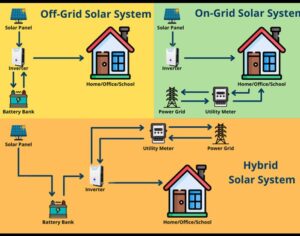
The Off-Grid System
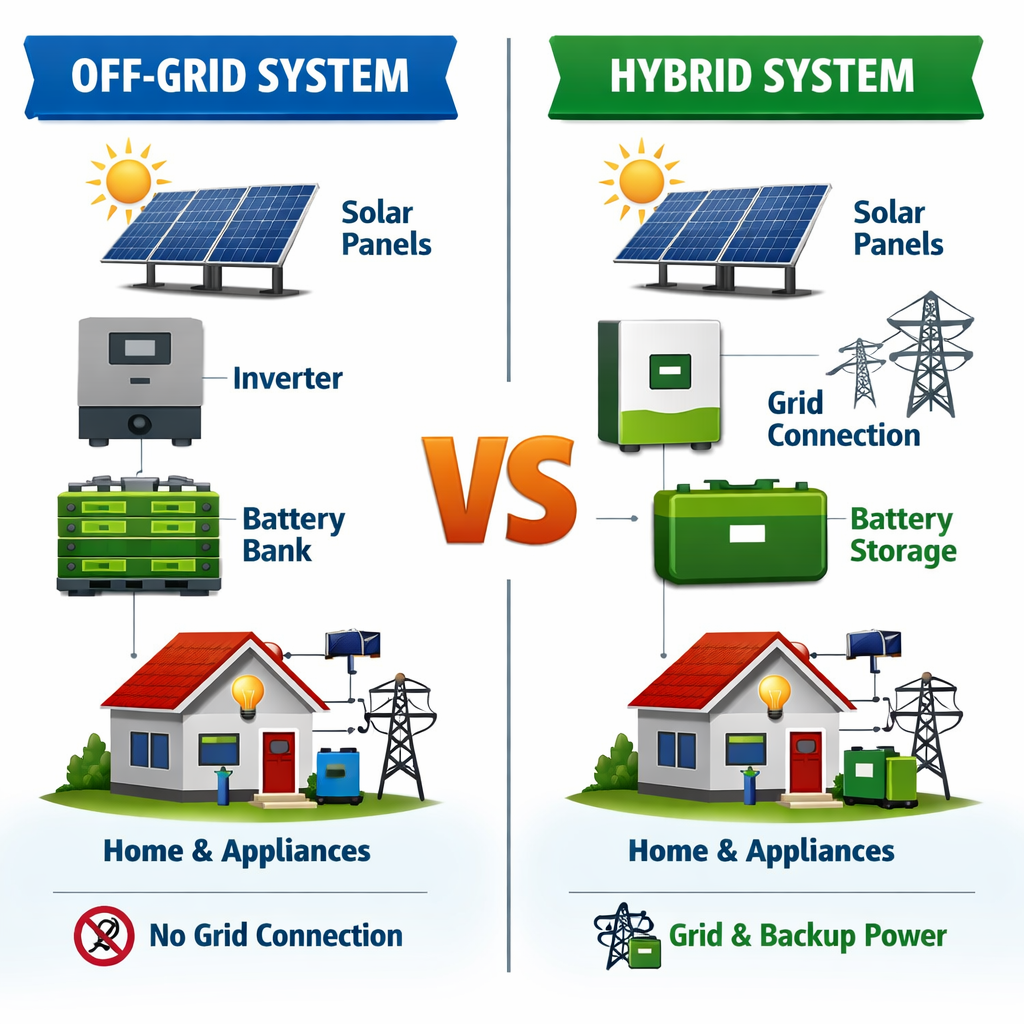
An off-grid solar system is a completely self-contained power plant. It has no connection to the national electricity grid. Every watt of electricity your home consumes must come from what the system generates and stores itself. There is no backup, no safety net, and no other source to draw from.
The electricity flow in an off-grid system moves in one direction: solar panels generate DC power → the charge controller manages and regulates that power → the battery bank stores it → the inverter converts stored DC power into AC electricity → your appliances run. When the panels are generating more than the home needs, excess goes to the battery. When the home needs more than the panels are producing, it draws from the battery. The system is always balancing generation, storage, and consumption.
The critical implication: The system must be large enough to meet 100% of your electricity needs under the worst realistic conditions — multiple consecutive cloudy days with the battery already depleted. This requirement drives the cost of off-grid systems significantly higher than hybrid alternatives.
The Hybrid System
A hybrid solar system connects to three sources simultaneously: solar panels, a battery bank, and the national electricity grid. A sophisticated hybrid inverter — the central intelligence of the system — continuously monitors all three sources and routes power based on a priority hierarchy it manages in real time.
The typical priority logic:
1. Solar power first— when panels are producing, supply the home directly from solar
2. Battery second— when solar is insufficient (night, cloud cover), draw from stored battery power
3. Grid third— when both solar and battery are inadequate, draw from the grid
4. Export fourth — when battery is full and solar is generating surplus, export to the grid (where net metering is available)
The consequence of having the grid as a third-tier backup is transformative for system sizing. You no longer need to size the battery bank for worst-case scenarios. If it is overcast for three consecutive days, the grid covers the gap. This means a hybrid system can use a significantly smaller and cheaper battery bank than an off-grid system serving the same household — a cost difference that can reach $3,000–$8,000 for a typical residential installation.
Off-Grid Systems: Components, Strengths, and Honest Limitations
The Components
Solar Panel Array
Off-grid systems typically require a larger panel array than equivalent hybrid systems because the panels must generate enough electricity to simultaneously power the home AND charge a large battery bank, with margin to spare on overcast days when output is reduced.
MPPT Charge Controller
For any serious off-grid home installation, an MPPT (Maximum Power Point Tracking) charge controller is non-negotiable. Because there is no grid to compensate for losses, you cannot afford the 15–30% efficiency deficit of cheaper PWM controllers. MPPT controllers extract maximum available power from the panels under all conditions — including partial cloud cover — and are essential for off-grid reliability. See our companion guide Solar Panel Sizes Explained for a full technical comparison of MPPT vs. PWM.
Battery Bank with Days of Autonomy
The battery bank is the most expensive and most critical component in an off-grid system. It must store enough energy to power the home through multiple days without meaningful solar generation. The standard design criterion for most of Africa is 2–3 days of autonomy — meaning the battery can supply 2–3 days of full household consumption with no solar input at all.
This autonomy requirement means off-grid battery banks are typically 2–4 times larger than those in equivalent hybrid systems. For a home consuming 10 kWh/day requiring 2.5 days of autonomy, the gross battery capacity required is:
10 kWh × 2.5 days ÷ 0.8 (LiFePO4 usable depth) = 31.25 kWh of battery capacity
At current African pricing, 30 kWh of quality LiFePO4 storage represents an investment of approximately ₦7.2 million – ₦12 million in Nigeria, R115,000 – R480,000 in South Africa, or KSh 600,000 – 1,800,000 in Kenya — before panels, inverter, or installation.
Many off-grid systems configure batteries in parallel strings rather than a single large battery, so that if one battery develops a fault, the remaining strings continue to supply power while the faulty unit is isolated and replaced.
Off-Grid Inverter/Charger
Off-grid inverters convert battery DC power to AC for household use and also manage battery charging from the panel array. A quality off-grid inverter includes a generator input port — allowing a backup petrol or diesel generator to charge the batteries during extended periods of low solar generation. This is not a compromise or failure of the off-grid concept; it is a practical contingency that virtually all serious off-grid installations maintain.
The Backup Generator: The Off-Grid Reality
The majority of homes operating on genuine off-grid solar still keep a small generator — used rarely, only when extended cloudy weather depletes the battery below 20–30% state of charge. Running a 2–3 kW generator for 3–4 hours every few months is a manageable contingency, not a daily burden. The generator’s role is emergency capacity insurance, not regular power supply.
Who Off-Grid Is Genuinely Right For
– Homes and businesses in locations where no grid connection exists or where a grid connection costs more than $3,000–$5,000 to install
– Properties in remote areas where grid supply is so unreliable that it offers no practical value as a backup
– Individuals with a genuine philosophical commitment to energy independence who accept the lifestyle discipline it requires
– Agricultural operations, telecom towers, water pumping stations, and remote facilities where grid extension is economically impractical
Hybrid Systems: Components, Strengths, and Honest Limitations
The Components
Solar Panel Array
Hybrid systems have more flexibility in panel array sizing because the grid serves as a backup. You can size the array for your typical daily consumption and peak solar production without needing to over-specify for worst-case cloudy-day scenarios. This said, a larger array still improves economics by increasing the proportion of consumption met by solar and reducing grid dependence.
See: Is Solar Power Worth It in Africa? A Financial and Technical Analysis
Hybrid Inverter: The System’s Brain
The hybrid inverter is a more sophisticated device than a standard off-grid inverter. It must:
– Synchronise with the grid’s AC frequency (50Hz across most of Africa) in real time
– Execute source switching in under 20 milliseconds — fast enough that computers and sensitive electronics do not detect the transition
– Manage bidirectional power flow (importing from grid when needed; exporting to grid where net metering is available)
– Apply programmable charge/discharge priorities that the user can customise
– Monitor and communicate system performance via WiFi to smartphone apps
This additional complexity is why hybrid inverters cost more than off-grid inverters of equivalent capacity. The cost premium is justified many times over by the reliability and convenience they deliver.
Battery Bank
Because the grid acts as a backup, the hybrid battery bank only needs to cover expected outage duration — not multiple consecutive days of zero solar generation. For urban South African homes managing load shedding, a battery sized to cover 6–8 hours at normal household load is typically sufficient. For Nigerian urban homes where grid availability is more erratic, a larger battery providing 12–18 hours of backup is more appropriate.
This distinction is significant: the same household that would need 30+ kWh of battery storage for an off-grid system might need only 10–15 kWh for a hybrid system that meets their practical needs — a cost saving of $3,000–$8,000 or more.
Net Metering and Feed-In Tariffs
In markets where net metering is available — currently South Africa (in municipalities including Cape Town, Johannesburg, Tshwane, and others), with growing policy frameworks in Kenya and Egypt — a hybrid system with export capability can earn credit for electricity fed back to the grid during the day. This shortens the payback period and improves the long-term return on investment.
Net metering is only possible with a hybrid (grid-tied) system. Off-grid systems cannot participate.
Who Hybrid Is Right For
– Urban and suburban homes with an existing grid connection in any African country
– Any location where power outages occur but grid power is available for at least some portion of the day
– Businesses that need maximum reliability with the grid as a fallback for heavy or sustained loads
– Buyers who want strong financial returns and the option of net metering where available
– Anyone who does not want to actively manage their daily energy consumption
Side-by-Side Technical Comparison
| Feature | Off-Grid System | Hybrid System |
|———|—————-|—————|
| Grid connection | None | Connected |
| Battery requirement | Mandatory — large capacity (2–3 days autonomy) | Mandatory — smaller capacity (outage duration only) |
| Panel array size | Larger (must cover worst-case generation days) | Flexible (grid covers shortfalls) |
| System reliability | Depends entirely on system sizing and design | Very high — solar, battery, and grid combined |
| Complexity | High — requires active energy management | Moderate — largely automated by inverter |
| Transfer time (grid failure) | Not applicable | 10–20 milliseconds (seamless) |
| Net metering eligibility | No | Yes (where available) |
| Upfront cost | Higher (large battery bank) | Moderate to high (smaller battery) |
| Monthly electricity bill | Zero (no grid connection) | Significantly reduced; may include standing charge |
| Lifestyle impact | Significant — energy awareness required | Minimal — system manages itself |
| Generator integration | Yes — standard contingency | Possible but rarely needed |
| Scalability | Can expand panels and batteries | Can expand panels, batteries, or inverter capacity |
| Best for | Remote areas, independence seekers | Urban/suburban, load shedding, bill reduction |
The African Context: How Country and Location Shape the Decision
The off-grid versus hybrid decision does not have a universal African answer. The right choice is shaped by local grid conditions, electricity costs, and the specific energy challenges of each country.
South Africa: Load Shedding as the Primary Driver
South Africa presents a specific case: a country with well-developed grid infrastructure, but one that implements scheduled rolling blackouts — load shedding — that have reached up to 12 hours per day in the most severe periods. For the overwhelming majority of South African homeowners, the grid exists, functions, and is worth keeping.
The hybrid system is the clear answer here. It provides seamless backup during load shedding while using the grid for heavy overnight loads that would require a prohibitively large battery bank to cover off-grid. Net metering, available in most major municipalities, improves the economics further. Going completely off-grid in South Africa — for a property with an existing grid connection — is almost always financially inefficient: you would pay for the capacity to handle scenarios the grid can cover perfectly well at lower cost.
Nigeria: When Hybrid Behaves Like Off-Grid
Nigeria presents a different challenge. In many urban areas — Lagos, Abuja, Port Harcourt, Ibadan — grid electricity is available but profoundly unreliable: 4–8 hours of actual supply per day is common, and extended outages lasting several days are not unusual. The line between “hybrid” and “off-grid” blurs significantly in this context.
Most new Nigerian solar installations are technically hybrid systems — they maintain a grid connection — but because grid availability is so low, the system operates primarily on solar and battery power, drawing from the grid opportunistically when supply coincides with battery depletion. The practical result is closer to off-grid operation than the South African hybrid experience.
The appropriate battery bank for a Nigerian urban hybrid system is therefore larger than a South African equivalent — typically 15–25 kWh for a medium household, sized to cover 18–24 hours of consumption, because the grid may not be available for that long.
Kenya: Off-Grid as First Access
Kenya has seen remarkable expansion of off-grid solar, particularly through PAYG (Pay-As-You-Go) financing models. For millions of rural Kenyan households, off-grid solar is not a lifestyle choice or an independence statement — it is the first electricity they have ever had access to, reaching communities where grid extension has not occurred and is not economically viable in the near term.
Kenya’s off-grid solar market is primarily served by smaller systems (100W–500W) via companies like M-KOPA, Greenlight Planet, and d.light, accessible through mobile money payment systems like M-Pesa. Urban Kenya, by contrast, is increasingly adopting hybrid systems as grid tariffs rise and reliability concerns grow.
Egypt and North Africa: Large-Scale Solar with Growing Residential Market
Egypt’s solar market has been driven primarily by large utility-scale projects — the Benban Solar Park being the most prominent example — but residential adoption is growing rapidly as electricity subsidies are reformed and grid tariffs rise. Both hybrid and off-grid systems are installed across Egypt, with hybrid systems dominant in urban areas and off-grid common in remote desert communities.
North Africa’s extreme heat (see our companion guide Best Solar Batteries for Africa’s Hot Climate makes battery storage design particularly important regardless of system type.
Ghana, Tanzania, Uganda, and Zambia: Rapidly Growing Markets
Across West, East, and Central Africa, solar adoption is accelerating as grid reliability remains inconsistent and electricity costs rise. Hybrid systems dominate urban markets; off-grid serves rural communities. The hybrid market in Ghana (particularly Accra and Kumasi) has grown substantially as PAYG financing makes larger systems accessible to middle-income households.
Cost Analysis: Upfront Investment and Long-Term Returns
The Battery Bank: Where the Cost Difference Lives
The central financial difference between off-grid and hybrid systems is battery bank sizing. Every other component — panels, inverter, cabling, mounting — costs broadly the same between equivalent systems. The battery bank alone can cost $5,000–$15,000 more in an off-grid system compared to a hybrid system serving the same household.
Here is a concrete illustration for a medium Nigerian household consuming 10 kWh per day:
Off-Grid Battery Requirement:
– 2.5 days of autonomy required
– 10 kWh × 2.5 ÷ 0.8 (DoD) = 31.25 kWh LiFePO4
– Approximate cost in Nigeria: ₦10,000,000 – ₦15,000,000
Hybrid Battery Requirement (same household):
– 18 hours of backup (typical Nigerian grid availability gap)
– 10 kWh × 0.75 (night portion) ÷ 0.8 (DoD) = 9.4 kWh LiFePO4
– Approximate cost in Nigeria: ₦3,000,000 – ₦5,000,000
Battery cost difference: ₦7,000,000 – ₦10,000,000 — for the same household, on the same street, meeting the same practical energy needs.
Payback Period Comparison
The higher upfront cost of an off-grid system, combined with zero electricity bills thereafter, creates a longer initial payback period than a hybrid system — but eventually delivers greater long-term financial return.
| Metric | Off-Grid | Hybrid |
|——–|———|——–|
| Typical upfront cost premium (over hybrid) | $4,000 – $12,000 | Baseline |
| Monthly electricity bill | Zero | Grid standing charge only (~$5–$20) |
| Typical payback period | 5 – 10 years | 3 – 6 years |
| 20-year total savings | Very high | High |
| Net metering benefit | Not available | Available where applicable |
Hybrid systems achieve faster payback because their lower upfront cost means less investment to recover before savings begin accumulating. Over a 20-year horizon, a large off-grid system may deliver slightly greater total financial return — but the hybrid delivers that return sooner and with less initial capital required.
The Grid Connection Fee Reality
Off-grid advocates correctly note that hybrid systems still attract monthly grid standing charges even when drawing very little from the grid. In South Africa, these standing charges range from approximately R150–R400 per month depending on municipality — R1,800–R4,800 per year. In Nigeria, grid supply is so unreliable in many areas that the practical cost of maintaining the connection is minimal.
This is a real cost difference, but it rarely changes the overall financial calculation significantly enough to justify the much larger battery bank investment required for off-grid operation in areas where the grid exists.
The Hidden Costs Both Systems Share
Whether you choose off-grid or hybrid, the following costs apply to both and are frequently underestimated or omitted from initial quotes.
Professional Installation and Compliance Certification
In South Africa, solar installations above a certain size legally require a Certificate of Compliance (CoC) issued by a registered electrician. This is not bureaucracy for its own sake — it is an insurance requirement. A solar-related fire in a property with an uncertified DIY installation will result in an insurance claim refusal. Similar requirements are in place or developing in Kenya, Nigeria, and Egypt.
Professional installation costs for a 5 kVA system range from approximately ₦200,000–₦500,000 in Nigeria, R18,000–R40,000 in South Africa, and KSh 30,000–70,000 in Kenya. This is not optional — it is part of the real cost of a properly installed system.
Mounting and Racking Hardware
Aluminium mounting rails, L-feet, clamps, and roof penetration flashings are required for any rooftop installation. In coastal areas — Lagos, Mombasa, Durban, Dakar — mounting hardware must be marine-grade stainless steel or anodised aluminium to resist salt air corrosion. Standard galvanised steel hardware corrodes within 2–3 years in coastal salt environments, compromising both the structural integrity of the installation and panel performance.
Mounting hardware typically adds $200–$600 to system costs for a residential installation, rising to $1,000+ for large commercial arrays.
DC and AC Protection Devices
DC surge protection devices (SPDs) at the panel array, AC SPDs at the inverter output, DC isolator switches, fusing and circuit breakers, and combiner boxes collectively add $300–$800 to a residential system. These are not optional extras — they are safety essentials and insurance requirements. Lightning is common across much of Africa, and an unprotected system can be destroyed by a single strike.
Solar Cable
UV-resistant, double-insulated solar-specific DC cable is required between panels and the charge controller or inverter. Standard electrical cable is not suitable — it degrades in UV exposure and is not rated for the DC voltages involved. For a 6-panel rooftop system, cable costs typically range from $100–$300 depending on roof layout and run distances.
Pros and Cons: The Complete Picture
Off-Grid: Advantages
Complete energy independence. You are unaffected by utility price increases, grid failures, national strikes affecting power supply, load shedding schedules, and any other grid-related disruption. Whatever happens to the national power supply, your home is insulated from it.
Zero grid electricity bills. Once the system is paid off, your electricity effectively costs nothing. Over 20+ years, the financial accumulation is substantial.
100% renewable energy. Every unit of electricity you consume comes from the sun. No fossil fuel generation, no grid losses, no carbon footprint from your electricity consumption.
Valuable for communities beyond the grid. In rural areas, off-grid solar is not just convenient — it is transformative. Healthcare, education, food storage, water pumping, and communications all become possible where they were previously impossible.
Off-Grid: Disadvantages
Highest upfront cost. The large battery bank required for off-grid autonomy is the most expensive component in any solar system. The total system cost for a genuine off-grid installation serving a medium household is typically 40–80% more than an equivalent hybrid.
Requires active energy management. Off-grid living demands ongoing awareness of your battery’s state of charge. On a sunny day after a clear week, you can run the air conditioning without concern. After three overcast days with the battery at 35%, you cannot. This lifestyle adjustment is manageable but real — and some households find it more constraining than expected.
Full system responsibility. If the battery underperforms, if a panel fails, if the inverter develops a fault — it is entirely your problem to solve. There is no grid to fall back on while repairs are underway.
Generator dependency in practice. Despite the off-grid label, most practical off-grid installations maintain a backup generator for extended low-solar periods. This introduces fuel costs and maintenance requirements — though at a much lower level than a full generator-dependent situation.
Hybrid: Advantages
Best of both worlds. Solar reduces your bills substantially. Batteries protect you from outages. The grid ensures you never run out of power under any circumstances.
Lower upfront cost. A smaller battery bank means significantly lower initial investment for equivalent practical reliability.
Fully automated operation. The hybrid inverter manages all source switching, charge management, and load prioritisation automatically. The system requires virtually no daily attention.
Net metering eligibility. Where available, the ability to export surplus solar to the grid and receive credit on your electricity account can further reduce bills and shorten the payback period.
Scalability. You can start with a modest system and expand panel capacity and battery storage incrementally as your budget allows — with the grid as a backstop throughout.
Hybrid: Disadvantages
Ongoing grid connection costs. Standing charges and any residual grid consumption represent a cost that never goes away, even if small.
Grid vulnerability remains. If the grid experiences a prolonged major failure and your battery bank is relatively small, you may run out of storage. This is a design issue — appropriately sized batteries address it — but it is a genuine consideration.
Grid dependency for heavy loads. Some loads — large air conditioning systems, electric water heaters, ovens — are expensive to run from battery storage alone. In a hybrid system, these loads are typically run during grid availability or peak solar production hours; in a pure off-grid system, they must be accommodated within the battery bank entirely.
Environmental and Social Impact
Reducing Grid Strain
Urban hybrid solar installations make a collective contribution beyond the individual household. When thousands of homes draw no power from the grid during daylight hours, the aggregate demand reduction eases pressure on ageing generation infrastructure. This deferred demand reduces the need for expensive diesel peaker plants and contributes to grid stability — benefiting non-solar households in the same supply area.
In South Africa, where residential and small commercial solar has grown dramatically since 2022, this collective demand reduction has contributed meaningfully to load shedding stage reductions — a real community benefit from individual solar investment decisions.
Energy Democracy and Decentralisation
Solar power — whether off-grid or hybrid — represents a fundamental shift in the energy relationship between citizens and the state. For generations, electricity in Africa has been controlled by large, often under-resourced state utilities, with millions of citizens dependent on those utilities for access to light, refrigeration, communication, and economic activity.
Solar disaggregates that dependency. A household with a solar system is not merely a consumer — it is a generator. This redistribution of energy generation capacity across millions of households and businesses represents a structural change in African energy systems that will reshape the continent’s energy economy over the coming decades.
Rural Off-Grid Impact
For communities beyond the grid, off-grid solar is not an alternative to existing power — it is the arrival of electricity for the first time. The documented impacts of solar electrification in rural Africa include improved educational outcomes (children able to study after dark), better healthcare (vaccine refrigeration, medical equipment, lighting in clinics), improved food security (solar water pumping for irrigation and refrigerated storage), and new economic opportunities (mobile phone charging services, small business operations, cottage industry).
These impacts, multiplied across millions of rural households across the continent, represent a social return on solar investment that extends far beyond the financial payback period.
The Decision Framework: Four Questions That Determine Your Answer
Work through these four questions in order. By the end, your appropriate system type will be clear.
Question 1: Is there a grid connection available at your property?
No grid connection exists, and connecting would cost more than $3,000–$5,000.
→ Off-grid is your only practical choice. Proceed to sizing your system for full autonomy.
No grid connection, but grid extension is feasible and affordable.
→ Evaluate whether grid connection plus a small hybrid system is cheaper than a full off-grid installation. In many peri-urban African areas, this calculation favours hybrid once grid connection costs are factored in.
Grid connection exists.
Question 2: What is the actual reliability of your grid supply?
Grid is available more than 12 hours per day on average.
→ Hybrid with a moderate battery bank (covering 8–12 hours of night and outage consumption) is appropriate. This describes most South African, Kenyan urban, Ghanaian urban, and Egyptian urban situations.
Grid is available less than 8 hours per day on average.
→ Hybrid remains appropriate but requires a larger battery bank — effectively operating as a near-off-grid system most of the time. This describes most Nigerian urban situations and some other West African cities.
Grid supply is so unreliable as to provide no practical backup value.
→ A hybrid inverter with off-grid capability, or a purpose-designed off-grid system, is more appropriate. The grid connection fee is the only reason to maintain the connection.
Question 3: What is your primary goal?
Maximum energy security with zero electricity bills and complete grid independence.
→ Off-grid if the budget supports the required battery bank. Requires acceptance of lifestyle discipline around energy management.
Backup power during outages, significant bill reduction, and ease of use.
→ Hybrid. This describes the majority of urban and suburban African solar buyers.
Lowest possible upfront cost with some energy independence.
→ Start with a hybrid system sized for your most critical loads. Expand over time.
Question 4: Are you prepared to actively manage your energy consumption?
Yes — I will monitor battery state of charge and adjust usage accordingly.
→ Off-grid is viable from a lifestyle perspective.
No — I want the system to manage itself without requiring daily attention from me.
→ Hybrid is the appropriate choice. The hybrid inverter manages source prioritisation, switching, and battery protection automatically.
Decision Summary
| Your Situation | Recommended System
| No grid access; remote location | Off-Grid |
| Grid access; South Africa load shedding | Hybrid (moderate battery) |
| Grid access; Nigeria/Ghana unreliable grid | Hybrid (larger battery) |
| Grid access; stable grid; bill reduction focus | Hybrid (smaller battery + net metering) |
| Deep rural; first electricity access | Off-Grid (PAYG entry system) |
| Complete independence; large budget | Off-Grid |
Maintenance: What Each System Demands From You
Off-Grid Maintenance
Daily (or near-daily): Monitor battery state of charge through the inverter display or monitoring app. Understand your battery’s current level and adjust high-consumption activities accordingly on low-charge days.
Monthly: Check that panel output is within expected range (compared to typical production for the season). Visually inspect cables and connections. Clean panels if dusty.
Every 6 months: Full connection inspection — check all terminal tightness, inspect cables for wear or heat damage, review battery performance against historical data to detect early capacity degradation.
Annually: Professional system inspection. Check all protection devices. Review generator condition and fuel supply if used for emergency backup. Assess whether system capacity remains appropriate for current consumption.
Hybrid Maintenance
Monthly: Review monitoring app data — check that solar production, battery cycling, and grid import are within expected parameters. Clean panels.
Every 6 months: Inspect inverter ventilation — clean cooling vents and verify fan operation. Check cable connections at inverter and battery terminals for tightness and signs of heat.
Annually: Professional inspection including all electrical connections, surge protection device condition, and battery health assessment.
The fundamental difference is this: an off-grid system requires your active participation in energy management as an ongoing lifestyle feature. A hybrid system is largely self-managing — the primary maintenance requirement is the same panel cleaning and periodic professional inspection that any solar installation needs.
References
1. EnergyBee.Off-Grid vs. Grid-Tied Solar South Africa 2025. Available at: energybee.co.za
2. Ajide, O.O. et al. Bridging Nigeria’s Urban Energy Gap: Assessing Hybrid Solar Systems. ScienceDirect, Renewable and Sustainable Energy Reviews. Available at: sciencedirect.com
3. Yale Climate Connections. For Climate and Livelihoods, Africa Bets Big on Solar Mini-Grids. New Haven: Yale Climate Connections. Available at: yaleclimateconnections.org
4. Megarevo. Off-Grid Solar Energy and Its Role in Solving Africa’s Power Crisis. Available at: megarevo.com
5. Chint Global. A Complete Guide to Hybrid Solar Systems. Available at: chintglobal.com
6. ResearchGate. Comparative Analysis Between Off-Grid and Hybrid Solar Options for Sub-Saharan Africa. Available at: researchgate.net
7. EnergyBee. Solar Panel Maintenance and Cleaning Guide South Africa 2025. Available at: energybee.co.za
8. Waweru, M. et al. Rural Solar Electrification: The Cases of Kenya, Ethiopia, and Rwanda. ScienceDirect, Energy Policy. Available at: sciencedirect.com
9. ScienceDirect. Performance Analysis of Hybrid Off-Grid Renewable Energy Systems for Remote Locations in Africa. Available at: sciencedirect.com
10. International Journal of Renewable Energy Development (IJRED). Comparative Analysis of Hybrid Renewable Energy Systems in Sub-Saharan Africa. Available at: ijred.undip.ac.id
11. EnergyBee. Solar Panel Efficiency Comparison South Africa 2026. Available at: energybee.co.za
12. Deo Solar. Regulations for Solar System Earthing in South Africa. Available at: deosolar.co.za
13. Lightning King. How to Ground a Solar Energy System for Lightning Protection. Available at: lightningking.co.za
14. STEPS Centre (Sussex). Pay-As-You-Go vs. Traditional Solar Finance Approaches in Kenya. Brighton: STEPS Centre. Available at: steps-centre.org
15. International Energy Agency (IEA). Africa Energy Outlook 2022. Paris: IEA, 2022. Available at: iea.org/reports/africa-energy-outlook-2022
16. International Renewable Energy Agency (IRENA). Off-Grid Renewable Energy Statistics 2023. Abu Dhabi: IRENA, 2023. Available at: irena.org/publications
Frequently Asked Questions
Can I convert a hybrid system to off-grid later?
Yes — most quality hybrid inverters (Sunsynk, Deye, Victron, Growatt) include an off-grid operating mode. Converting a hybrid system to function as off-grid primarily requires adding battery capacity and potentially additional solar panels to achieve the autonomy needed without grid backup. The inverter itself does not need to be replaced. This makes a hybrid system an excellent starting point — you can expand into near-off-grid operation as your budget and needs evolve.
Do solar panels still produce electricity on cloudy or rainy days?
Yes, but at significantly reduced output — typically 10–30% of their peak rated capacity depending on cloud thickness. This is why battery storage matters in both system types, and why the grid backup in a hybrid system is particularly valuable during extended rainy seasons. Quality monocrystalline panels, especially PERC and TOPCon variants, perform relatively better than older polycrystalline panels in low-light conditions.
What happens to a hybrid system during a complete grid failure?
A quality hybrid inverter with sufficient battery storage continues to supply the home with no interruption — switching from grid to battery in under 20 milliseconds. Most appliances, including computers, do not detect the transition. If the battery becomes depleted during a prolonged outage and the grid has not returned, consumption must be reduced to essential loads or a backup generator connected. This scenario is rare in practice for properly sized systems.
Is an off-grid system completely maintenance-free?
No solar system is completely maintenance-free, but off-grid systems require more active engagement than hybrid systems. Panel cleaning is required regularly (monthly in dusty climates). Battery state of charge should be monitored and energy consumption adjusted on low-charge days. Generator condition should be checked periodically if one is maintained for emergency backup. Annual professional inspections are recommended for both system types.
Which system qualifies for South Africa’s solar tax incentive?
Both system types may qualify, but the practical benefit is primarily realised through grid-connected installations. South Africa’s Section 12B accelerated depreciation applies to businesses. The individual household solar rebate that was introduced in 2023 applied to new solar panel purchases — check with SARS for current qualifying conditions. Net metering benefits (where applicable) only apply to hybrid systems with grid connection and export capability.
How do I know if my area has net metering in South Africa?
Contact your local municipality’s electricity department directly. Major municipalities with established net metering programmes include the City of Cape Town, City of Johannesburg (Johannesburg City Power), City of Tshwane, Ekurhuleni, and others. The South African Photovoltaic Industry Association (SAPVIA) maintains current information on municipal net metering status. Requirements and application processes vary by municipality.
What size battery do I need for an off-grid system in Nigeria?
For a typical Nigerian urban household consuming 10–12 kWh/day with 2.5 days of autonomy, a gross LiFePO4 battery capacity of 30–40 kWh is required. This typically means 6–8 Pylontech US5000 units (4.8 kWh each) or equivalent capacity from other LiFePO4 brands. For rural households with lower consumption (5–6 kWh/day), 15–20 kWh of storage is often sufficient with 2 days of autonomy designed in. Always use the step-by-step sizing methodology in our companion article Solar Panel Sizes Explained for precise calculations based on your specific load profile.
Conclusion
The off-grid vs hybrid solar systems decision is ultimately not about which system is better in the abstract — both are excellent technologies solving real energy problems across Africa every day. It is about which system is right for your specific situation: your location, your grid reality, your budget, your lifestyle, and your long-term goals.
For the majority of urban and suburban African homeowners — in South Africa dealing with load shedding, in Nigeria dealing with a few hours of grid supply daily, in Kenya dealing with rising tariffs, or in Ghana dealing with unreliable supply — The hybrid system is the right choice. It offers the best balance of cost, reliability, and convenience, with the grid acting as a safety net that eliminates the need for the expensive battery overcapacity that defines off-grid design.
For those beyond the grid’s reach — rural communities across East, West, and Central Africa where the grid does not exist and is not coming soon — off-grid is not a choice but an opportunity: the chance to leapfrog the infrastructure limitations that have held communities back and to build a clean, reliable, locally controlled energy supply from scratch.
Whichever system you choose, you are making a decision that will serve your home or business for the next 20–30 years, reduce your dependence on an unreliable and increasingly expensive energy status quo, and contribute to Africa’s broader energy transformation.
Make the decision with clear information. Install with certified professionals. Choose quality components. And then enjoy what millions of African solar users already know: reliable electricity, on your terms.
In conclusion off-grid vs hybrid solar systems will depend on your perculiar case and country of residence.
Related Articles in This Series:
– How Much Does Solar Power Cost in Africa in 2026? (Panels, Batteries & Installation)
– Best Solar Batteries for Africa’s Hot Climate: A Complete Buying Guide (2026)
– Best Solar Inverters for Africa: Complete Buying Guide (2026)
– Solar Panel Sizes Explained: A Complete Engineering Guide for African Homes (2026)
– Is Solar Power Worth It in Africa? A Financial and Technical Analysis (2026)
– What Is Solar Energy and How It Works in Africa: A Complete Technical Guide (2026)