
Solar Energy in Africa 2026: Record Growth and What It Means for Your Home
Something significant happened in African energy in 2025. For the first time in the continent’s history, solar energy additions crossed the 4.5 gigawatt (GW) mark in a single year — a 54% increase over 2024 and the fastest annual solar growth Africa has ever recorded.
That figure comes from the Africa Market Outlook for Solar PV: 2026–2029, published in February 2026 by the Global Solar Council (GSC) — the leading international body tracking solar energy in Africa deployment worldwide. The report does not just confirm that solar energy in Africa is growing. It shows that growth is accelerating, spreading to new countries, and increasingly being driven by ordinary homes and businesses rather than just government power plants.
This article unpacks what those numbers mean, which countries are leading, and — most practically — what the boom in solar energy in Africa means for your home or business right now.
Table of Contents
1. Africa’s Solar Energy Record: Understanding the Numbers
2. Why Solar Energy in Africa Is Growing This Fast
3. Countries Leading Africa’s Solar Expansion
4. What This Means for Homes and Businesses
5. Challenges That Still Need Solving
6. What the Next Four Years Look Like
7. References
8. Frequently Asked Questions
Africa’s Solar Energy Record: Understanding the Numbers
The 4.5 GW added across Africa in 2025 is worth putting in context. One gigawatt of solar power can supply approximately 150,000–200,000 average African homes with electricity. Four and a half gigaatts therefore represents the equivalent of powering 675,000 to 900,000 homes — added in a single year.
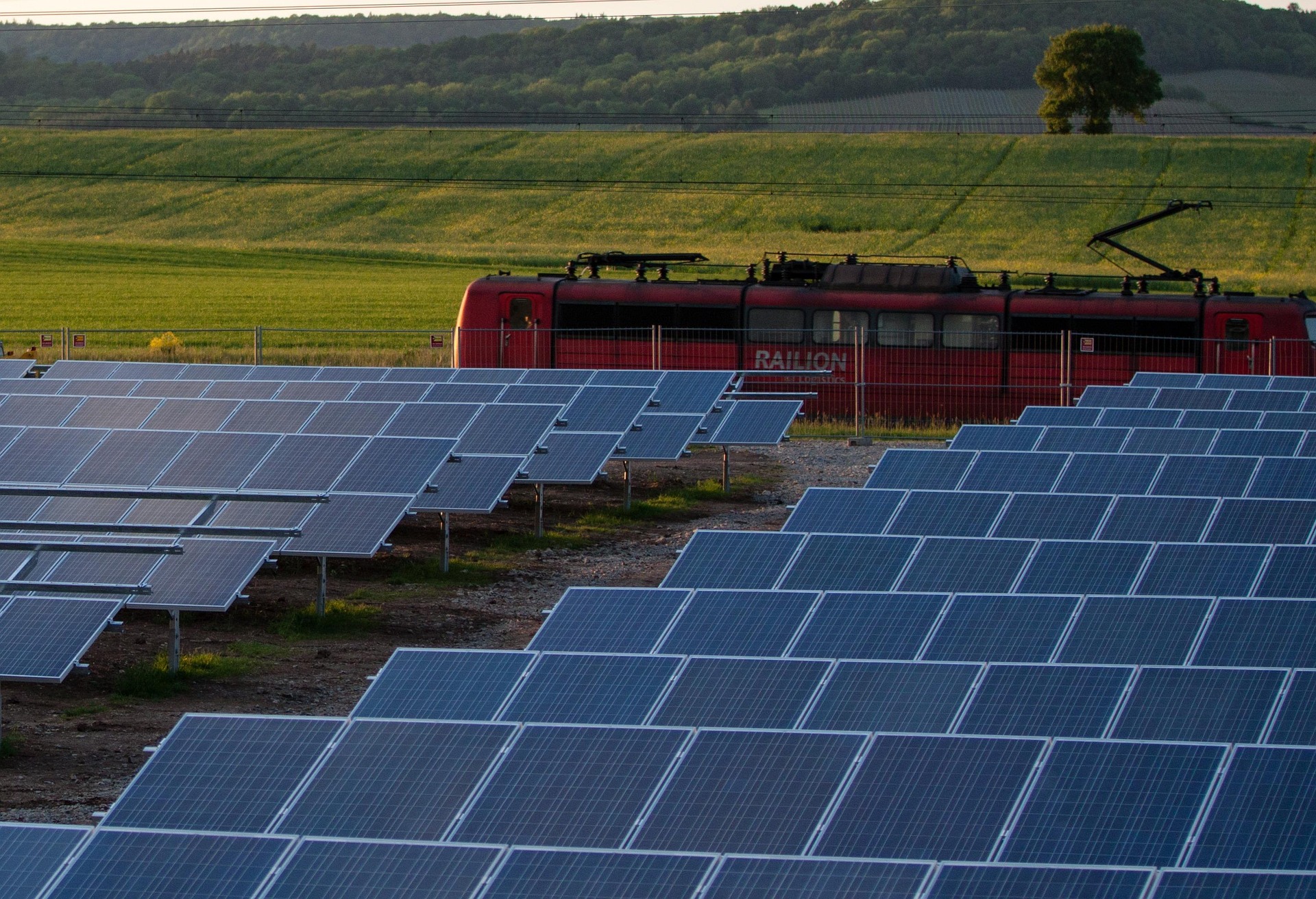
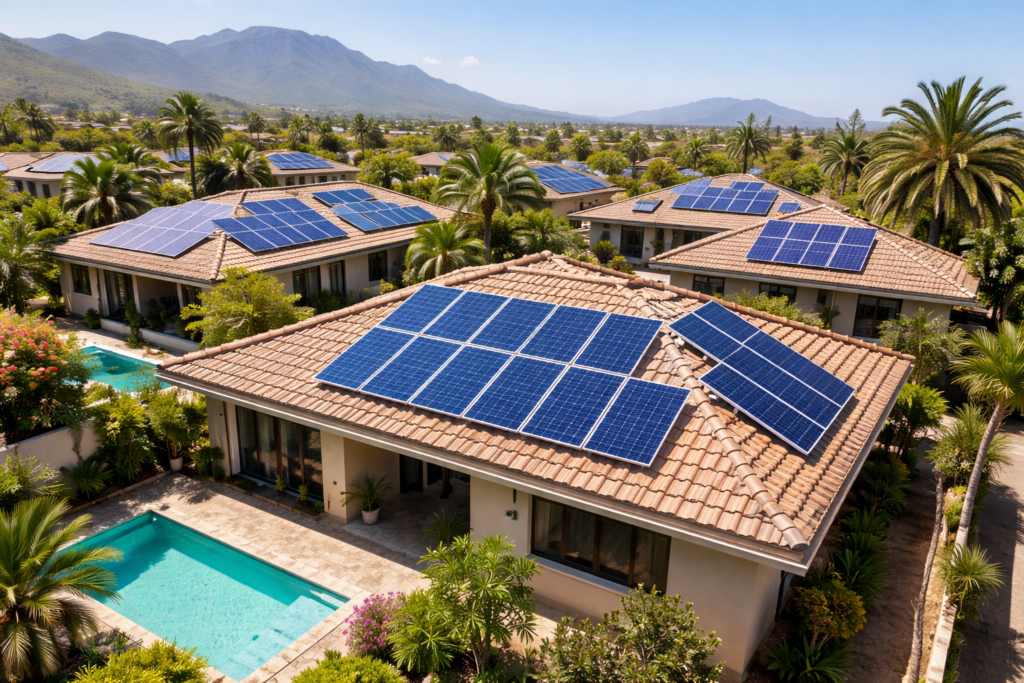
What makes this particularly significant is not just the total volume but the composition. According to the GSC report, roughly half of the new installations were utility-scale systems — large solar parks connected directly to national grids. The other half were distributed systems — panels installed on rooftops and at individual homes, businesses, schools, clinics, and farms.
That 50-50 split matters. It means solar energy in Africa is no longer primarily a story about governments building large power plants. It is increasingly a story about individual decision-makers — homeowners, shop owners, school administrators — choosing solar to solve their own energy problems.
The GSC report also highlights that eight African countries each added more than 100 megawatts (MW) of solar capacity in 2025. In 2024, only four countries crossed that threshold. The doubling of this figure shows that solar energy in Africa is growing spreading geographically, not just deepening in markets that were already active.
Why Solar Energy in Africa Is Growing This Fast
The 54% growth in solar energy across Africa in 2025 did not happen by accident. Several converging forces are behind it.
Panel and Battery Prices Are at Historic Lows
The global price of solar panels has fallen by more than 90% over the past fifteen years, driven primarily by the enormous expansion of Chinese manufacturing. By early 2026, panels are available at approximately $0.14 per watt— meaning a 400W residential panel costs roughly $56 at the source, before shipping and local distribution margins.
Battery storage costs have followed a similar path, with LiFePO4 battery pack prices falling over 80% since 2015. This price trajectory has brought solar within financial reach for households and businesses that would have found it unaffordable five years ago.

600 Million People Still Need Reliable Power
Despite the growth, sub-Saharan Africa still has an electrification challenge of historic proportions. According to the International Energy Agency (IEA), approximately 600 million people on the continent lack access to reliable electricity. For this population, solar is not a sustainable choice — it is a practical necessity, often representing the first reliable electricity their household has ever had.
Even in cities with grid connections, reliability is the central problem. In Nigeria, urban households receive an average of 4–8 hours of grid power per day. In Zimbabwe, scheduled blackouts regularly exceed 12 hours. In Ghana, load shedding periods have returned. Solar energy in Africa increasingly fills the gap between what the grid promises and what it actually delivers.
Regulation Is Catching Up
Governments across Africa are increasingly creating the regulatory conditions that make solar investment more attractive. Nigeria’s 2023 Electricity Act — one of the most significant energy policy reforms in the country’s history — devolved electricity regulation to state level and created a framework for net metering, allowing solar owners to sell surplus electricity back to the grid. South Africa has streamlined the approval process for residential solar installations. Kenya zero-rates VAT on solar products. Egypt has introduced feed-in tariff mechanisms for renewable energy projects.
These regulatory changes reduce the cost and complexity of going solar, accelerating adoption across all market segments.
The Generator Economy Is Becoming Unsustainable
African businesses and households collectively spend an estimated $20 billion per year on diesel and petrol for private generators — money that funds energy security for those who can afford it while doing nothing to improve underlying infrastructure. As fuel prices remain elevated and generator maintenance costs accumulate, the economics of switching to solar become more compelling with each passing year.
Countries Leading Africa’s Solar Expansion
The GSC report identifies the countries driving Africa’s record solar year. Here is the picture by market:
| Country | New Solar Added (2025) | Key Growth Driver | Home/Business Value in 2026 |
| South Africa | 1.6 GW | Load shedding; rooftop boom; policy support | Excellent — payback 3–5 years |
| Nigeria | 803 MW (+141% year-on-year) | Grid unreliability; generator replacement | Outstanding — especially replacing diesel costs |
| Egypt | 500 MW | Utility-scale desert parks; good irradiance | Strong and growing for homes |
| Algeria | 400 MW | Government expansion plans; vast sunny land | Primarily large-scale; home market developing |
| Morocco | 204 MW | Renewable target of 52% by 2030 | Solid in high-irradiance regions |
| Others (Zambia, Tunisia, Botswana, Ghana, Chad) | 100 MW+ each | Varied — grid gaps, PAYG, policy reform | Growing in each market |
*Source: Global Solar Council, Africa Market Outlook for Solar PV: 2026–2029 (February 2026)
South Africa: The Rooftop Revolution
South Africa’s 1.6 GW — the continent’s largest addition — was driven significantly by the residential and small commercial rooftop market. Load shedding, which reached Stage 6 in its worst periods (up to 12 hours without power per day), pushed homeowners and businesses to invest in hybrid solar systems at a pace that surprised even industry analysts. Policy changes in 2023–2024 streamlined installation approval and introduced tax incentives, further accelerating uptake.
Nigeria: The Fastest Growth Story
Nigeria’s 141% year-on-year increase is the most striking individual country figure in the GSC report. It reflects a fundamental shift in how urban Nigerians are approaching their energy problem — moving from diesel generator dependency toward solar as the primary power source, with the grid used opportunistically when available. At ₦140–₦220 per unit for grid power and with generators consuming expensive fuel daily, the financial case for solar in Nigeria is among the strongest on the continent.
Egypt: Where Scale Meets Sunshine
Egypt’s 500 MW addition was dominated by utility-scale projects benefiting from the Sahara’s exceptional solar irradiance — among the highest in the world. The residential and commercial market is smaller but growing as electricity subsidies are progressively reformed and retail tariffs rise toward cost-reflective levels.
What This Means for Homes and Businesses
The record growth in solar energy in Africa in 2025 has direct practical implications for anyone considering a solar installation in 2026.
Prices Are Lower and Supply Is More Reliable
The combination of falling global panel prices and the growth of Africa’s solar distribution network means that in 2026, you can access quality solar components at better prices and from more local suppliers than at any previous point. Competition among suppliers and installers — particularly in Nigeria, South Africa, and Kenya — benefits buyers.
The Technology Is Proven in African Conditions
Five years ago, questions remained about how solar systems would perform in African heat, dust, and humidity over time. Those questions now have answers — from thousands of real installations across the continent. We know which battery chemistries survive the heat (LiFePO4), which inverter brands hold up over years of daily switching cycles, and which panel types maintain output in tropical temperatures. The knowledge base for making good solar decisions in Africa has never been better.
Your Payback Period Is Shorter Than Ever
The combination of lower system costs and rising electricity and fuel prices has compressed solar payback periods across African markets. For a Nigerian household currently spending ₦150,000–₦200,000 per month on generator fuel, a quality hybrid solar system can pay for itself in under two years. For a South African home reducing a significant Eskom bill, payback in 3–5 years is realistic. For a Kenyan business replacing grid-plus-generator costs, 2–4 years is achievable.
After payback, the electricity produced by your solar panels costs you essentially nothing for the remaining 20+ years of the system’s life.
Financing Has Never Been More Accessible
The growth of solar energy in Africa has brought financing innovation alongside technology. Pay-As-You-Go (PAYG) platforms have expanded access to solar for lower-income households across East and West Africa, while commercial banks in South Africa, Kenya, and Nigeria now offer solar-specific loan products. Government incentive programmes in South Africa, Kenya, and Nigeria have added further financial support mechanisms.
Challenges That Still Need Solving
The GSC report is candid about the obstacles that remain. Acknowledging them is important for anyone making investment decisions.
**Grid connection and interconnection barriers** remain a significant constraint for utility-scale projects in many countries, where transmission infrastructure has not kept pace with generation capacity ambitions.
Access to affordable financing remains difficult for the majority of African households. While PAYG has expanded access significantly at the smaller end of the market, financing for medium and large residential systems (those costing $3,000–$10,000) remains limited outside South Africa and Kenya.
Import duty structures in some countries increase the landed cost of solar equipment, slowing adoption. Policy consistency — where tax incentives and net metering rules are introduced but later amended or withdrawn — creates investment uncertainty.
Installation quality varies widely. The rapid growth of the solar market has attracted many installers with limited training, and poorly designed or installed systems give solar a bad reputation while leaving customers with underperforming or dangerous installations. Certification and quality control frameworks are developing but remain incomplete in many markets.
What the Next Four Years Look Like
The GSC’s Africa Market Outlook for Solar PV: 2026–2029 projects that the continent will add over 33 GW of new solar capacity by 2029 — more than seven times the 2025 record addition. This projection reflects continued panel price declines, growing policy support across more countries, expanding financing infrastructure, and the compounding effect of installer and supply chain capacity built during the current growth phase.
The distributed solar market — home and business installations — is expected to grow proportionally faster than utility-scale, as urban energy access challenges drive individual investment decisions independently of government programmes.
For homeowners and businesses making decisions today, this outlook has a practical implication: the conditions driving solar growth — falling costs, improving technology, rising grid electricity prices — are expected to continue. But so is the one argument for acting sooner rather than later: every month of delay is another month of generator fuel, grid bills, and outage costs that a solar system would have eliminated.
References
1. Global Solar Council (GSC). Africa Market Outlook for Solar PV: 2026–2029. Washington, D.C.: GSC, February 2026. Available at: globalsolarcouncil.org/resources/africa-market-outlook-2026-2029
2. Global Solar Council (GSC). Press Release: Africa Records Its Fastest Year of Solar Growth as Installations Rise 54% Year-on-Year. February 3, 2026. Available at: globalsolarcouncil.org/news/africa-records-fastest-year-solar-growth
3. International Energy Agency (IEA). Africa Energy Outlook 2022. Paris: IEA, 2022. Available at: iea.org/reports/africa-energy-outlook-2022
4. International Renewable Energy Agency (IRENA). Renewable Power Generation Costs in 2023.Abu Dhabi: IRENA, 2024. Available at: irena.org/publications
5. BloombergNEF. Solar Module Price Index, Q1 2026. New York: BloombergNEF, 2026. Available at: about.bnef.com
6. Nigerian Electricity Regulatory Commission (NERC). Electricity Act 2023: Net Metering and Distributed Generation Framework. Abuja: NERC. Available at: nerc.gov.ng
7. South African Revenue Service (SARS). Solar Energy Tax Incentives — Residential and Business. Available at: sars.gov.za
8. Kenya Revenue Authority (KRA). VAT Zero-Rating for Solar Energy Products. Nairobi: KRA. Available at: kra.go.ke
Frequently Asked Questions
How much solar power did Africa add in 2025?
Africa added 4.5 gigawatts (GW) of new solar capacity in 2025 — a 54% increase over 2024 and the fastest annual solar growth in the continent’s history. This data comes from the Global Solar Council’s Africa Market Outlook for Solar PV: 2026–2029, published in February 2026.
Which African country added the most solar power in 2025?
South Africa led with 1.6 GW of new solar capacity, driven primarily by the residential rooftop market responding to severe load shedding. Nigeria came second with 803 MW, representing a 141% year-on-year increase — the fastest growth rate among major markets.
How does Africa’s solar growth benefit ordinary households?
Record solar growth brings three direct benefits for households: lower equipment prices as supply chains scale up, more local installer competition improving service quality, and a broader proven track record of systems performing well in African conditions. All three factors improve the financial case for individual solar investment.
Is it a good time to invest in solar in 2026?
Yes — by most financial measures, 2026 is among the best times in history to invest in solar in Africa. Panel prices are at historic lows, battery technology has improved significantly, financing options are expanding, and the cost of not going solar — in generator fuel, grid bills, and outage losses — continues to rise. Payback periods are shorter than they have ever been.
Will solar prices keep falling after 2026?
The GSC report and broader industry analysis project continued price declines through 2029. However, currency exchange rate movements, import duty changes, and supply chain disruptions can affect local prices independently of global trends. Waiting for prices to fall further while continuing to spend on generators and grid electricity is rarely the optimal strategy — the money spent in the interim exceeds the potential future savings from cheaper equipment.
What is a gigawatt (GW) in practical terms?
One gigawatt equals 1,000 megawatts, or 1,000,000 kilowatts. A single GW of solar capacity, operating under typical African sun conditions, can generate enough electricity to supply approximately 150,000–200,000 average African homes. Africa’s 4.5 GW addition in 2025 therefore represents potential power supply for roughly 675,000–900,000 additional households.
Conclusion
Solar energy in Africa has crossed a threshold. The 4.5 GW added in 2025 is not just a record — it is evidence that solar has moved from a niche alternative to a mainstream energy solution across the continent. Eight countries crossing the 100 MW mark in a single year shows the breadth of adoption. Nigeria’s 141% growth shows the depth of demand. And the 50-50 split between utility-scale and distributed installations shows that households and businesses are driving this revolution alongside governments.
The GSC’s projection of 33 GW of additional solar by 2029 is not wishful thinking. It is a projection based on falling costs, expanding financing, improving regulation, and an energy need that has not gone away. Africa has the strongest solar resource in the world and one of the largest unmet electricity needs. Those two facts will continue to drive solar energy growth on the continent for the foreseeable future.
If you are a homeowner or business owner in Africa reading this in 2026, the question is not whether solar will work. Millions of installations across the continent have already answered that. The question is when you will start.
Related Articles in This Series
– Off-Grid vs. Hybrid Solar Systems: Which Is Right for You in Africa? (2026)
– How Much Does Solar Power Cost in Africa in 2026?
– Best Solar Inverters for Africa: Complete Buying Guide (2026)
– Best Solar Batteries for Africa’s Hot Climate: Complete Buying Guide (2026)
– Is Solar Power Worth It in Africa? A Financial and Technical Analysis (2026)