

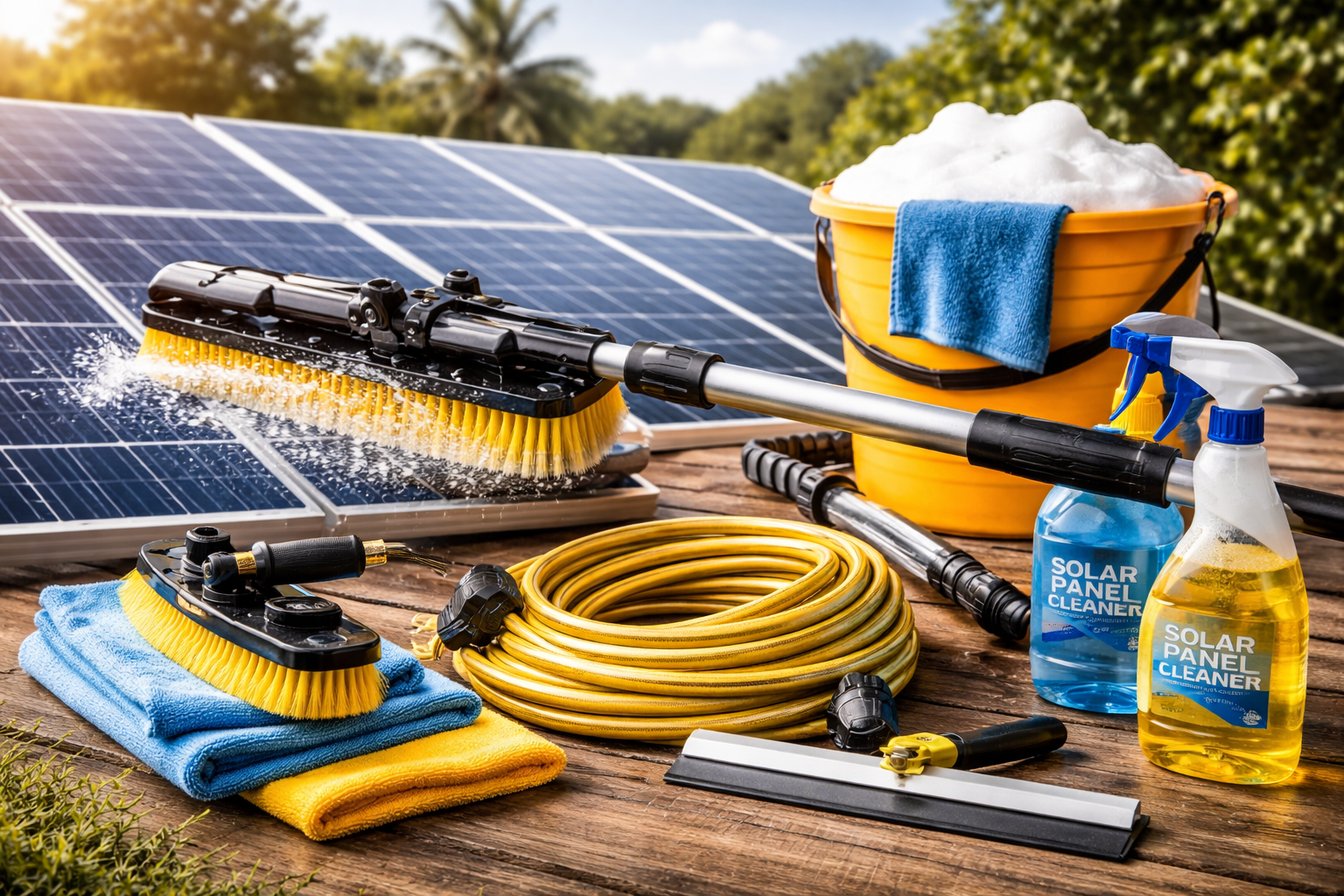
Best Tools to Clean Solar Panels: Safe and Affordable Options for African Buyers

Best Tools to Clean Solar Panels: Safe and Affordable Options for African Buyers.
Ask most solar owners in Africa their best tools to clean solar panels and you will get one of two answers: either they use whatever is nearby — a rag, a broom, a bucket of water from the tap — or they do not clean them at all because they are not sure what is safe.
Both approaches cost money. The wrong cleaning tools scratch the glass surface of solar panels, and those scratches are permanent. Every scratch reduces the amount of sunlight that passes through to the cells below. Over months and years, that damage quietly reduces your system’s output in a way that no amount of future cleaning can undo.
The right tools, on the other hand, are simple, affordable, and available across Africa. You do not need specialised equipment or expensive imported products. You need the right items, used the right way. This guide explains exactly what they are, where to get them, and what to avoid.
The most expensive cleaning mistake is not what you use — it is scratching a panel once and spending the next twenty years paying for it in lost output.
Read: How to Clean Dust from Solar Panels in Nigeria and Africa
Why the Right Tools Actually Matter
Solar panels look robust — they sit outside in the sun, rain, and wind every day of the year. But the glass surface that covers the solar cells is precision engineering. It is treated with an anti-reflective coating designed to maximise the amount of light that passes through. That coating is thin and can be damaged by abrasive materials, harsh chemicals, or high-pressure water.
When that coating is scratched or chemically stripped, light reflects off the surface instead of passing through to the cells. The cells receive less energy. Your output drops. There is no repair — only replacement.
This is not a theoretical risk. It is the most common form of self-inflicted panel damage, and it happens because people reach for whatever cleaning tool is closest without knowing what it does to the glass.
The good news is that the correct tools cost less and are easier to find than the damaging ones. Here is what you need.

The 6 Tools That Work
Microfibre Cloth — Your most important tool
A microfibre cloth is the single most important item in your solar cleaning kit. The fibres in microfibre are split at a microscopic level, which allows them to pick up and hold fine particles — including dust, pollen, and the kind of gritty harmattan residue common across West Africa — without dragging them across the glass surface.
Compare this to a regular cotton cloth or rag, which pushes particles sideways rather than lifting them. On glass, that is the difference between cleaning and scratching.
What to Look For
GSM rating of 300 or above. GSM stands for grams per square metre and measures the density of the cloth. A higher GSM means a thicker, softer cloth that holds more water and is gentler on glass. Many cheap microfibre cloths sold in markets are below 200 GSM — too thin and often not properly split-fibre.
Size of at least 40 x 40 cm. Larger cloths let you clean more surface area with each stroke and reduce the number of passes needed, which reduces the risk of pressing grit across the panel.
Two cloths minimum. Use one damp cloth for washing and a second dry cloth for wiping off water marks after rinsing. Water left to evaporate on a panel in direct sun leaves mineral deposits.
Where to Buy in Africa
Microfibre cloths are widely available at supermarkets, car accessories shops, and hardware stores across Nigeria, Ghana, Kenya, South Africa, and most other African countries. They are sold under names like ‘microfibre cleaning cloth,’ ‘glass cloth,’ or ‘car detailing cloth.’ A pack of four or five costs between $2 and $6 depending on your country. Avoid very cheap single cloths from roadside vendors — they are often regular polyester, not true microfibre.
Pro tip: Wash microfibre cloths separately from regular laundry and never use fabric softener. Softener coats the fibres and destroys their cleaning ability. Hang to dry rather than tumble dry.
Read: Solar Energy in Africa 2026: Recording Significant Growth
Clean, Low-Mineral Water — The foundation of every clean
Water is what loosens and lifts the dirt your cloth then removes. But not all water is equally good for solar panels — and in parts of Africa with hard water, the difference matters.
Hard water contains high levels of dissolved minerals, particularly calcium and magnesium. When hard water evaporates on a solar panel, it leaves white or chalky mineral deposits on the glass — the same marks you see on taps and tiles in areas with hard water. On a solar panel, these deposits reduce light transmission and attract more dust. Over time, they build up into a persistent haze that is much harder to remove than ordinary dust.
Best Water Options, in Order of Preference
Rainwater, collected fresh and used the same day, is the best option. It is naturally soft and free of minerals.
Filtered or purified water (the kind sold in sachets or small bottles) is the next best option — though using it in large quantities becomes expensive.
Borehole or well water varies significantly by location. If your borehole water is known to be soft, it works fine. If it leaves deposits on surfaces, do not use it on panels.
Municipal tap water is acceptable in many African cities where treatment keeps mineral content moderate. Test by letting a drop dry on a dark surface — if it leaves a white ring, the mineral content is too high for panels.
How Much Water You Need
For portable or ground-mounted panels, two to three litres of water is enough for a thorough clean. For a rooftop system of six to twelve panels, plan for ten to fifteen litres. You do not need to flood the panels — a damp cloth followed by a gentle rinse is more effective than soaking.
Warning: Never use water from a coastal well or any source that may contain salt. Salt deposits on solar glass are particularly damaging and significantly harder to remove than ordinary mineral deposits.
Soft-Bristle Brush with Long Handle — For dry dust removal and hard-to-reach panels
Before you apply any water, brushing loose dust off the panel surface first reduces the amount of grit that your wet cloth has to deal with. This matters because dust grains, when wet, become slightly adhesive and are more likely to be dragged across the glass under pressure rather than lifted cleanly.
A dry brush pass before the wet clean is especially valuable in dusty environments: the Sahel during dry season, laterite regions of East and Central Africa, and urban areas near unpaved roads. In these locations, a thick layer of dust that is immediately wetted becomes a mud-like paste that is harder to remove without scrubbing.
What to Look For
Bristles rated for glass or delicate surfaces. Brushes designed for washing cars, window cleaning, or solar panels specifically are suitable. Avoid stiff-bristle brushes sold for scrubbing floors, walls, or dishes.
Handle length of at least 1 to 1.5 metres. Rooftop panels need to be reached without leaning over them or placing weight on the mounting structure. A long handle also lets you clean from a safe standing position at the roof edge.
Rotating or adjustable head, if available, allows you to match the panel angle without contorting the handle.
Where to Buy in Africa
Car wash brushes with soft natural or synthetic bristles are the most common locally available option and work well. Look for them at car accessories shops, hardware stores, or market stalls that sell cleaning supplies. A decent long-handled soft brush costs between $3 and $10 in most markets. If you cannot find one locally, an online order from Jumia, Takealot, or a forwarding service from Amazon is a practical option.
Pro tip: Label your solar cleaning brush and keep it separate from brushes used for floors or outdoor surfaces. Cross-contaminating with cleaning chemicals used elsewhere is a common but invisible source of panel damage.
Low-Pressure Garden Hose — For rinsing large installations
A standard garden hose at normal tap pressure is the right tool for rinsing panels after washing. It removes soap residue, loose dirt, and the dirty water from cleaning — all of which, if left to dry on the panel, would leave deposits.
The key word is low pressure. A garden hose at normal residential water pressure is perfectly fine. What you must avoid is adding any pressure-boosting attachment, using a pressure washer, or turning the tap pressure higher than normal.
Correct Hose Technique
Use a gentle spray nozzle set to a wide, soft fan pattern. Avoid jet settings that concentrate water force on a small point.
Rinse from the top of the panel downward, letting water carry dirt away from the clean upper surface rather than pooling at the bottom.
Keep the hose nozzle at least 30 centimetres from the panel surface. The closer you hold it, the more pressure hits the glass.
Rinse once with clean water after washing and once more if you used soap. Soap film left on panels dries to a thin layer that attracts more dust than a clean surface.
What to Do Without a Hose
If your installation is on a rooftop without hose access, or if you are using portable panels away from a water source, use a second bucket of clean water for rinsing. Pour slowly from a height, allowing gravity to carry the rinse water down the panel. A watering can with a rose head also works well for controlled, gentle rinsing.
Warning: Never point a hose at the cable connections, junction boxes, or the inverter housing. These are not waterproof under direct water pressure. Aim only at the glass surface of the panel.
Mild Dish Soap or Solar Panel Cleaning Solution — For heavy soiling only
For routine cleaning — removing ordinary dust and light dirt — plain water and a microfibre cloth is all you need. Soap is only necessary when panels have a heavier layer of soiling: bird droppings, soot from cooking fires, oil residue from traffic, or the sticky black deposits common near industrial areas.
When soap is needed, the right type matters. The same logic that applies to washing delicate glassware applies here: gentle, pH-neutral, and low-residue.
Soaps That Are Safe
Mild liquid dish soap in very small quantities — a few drops in a full bucket of water. Brands like Sunlight Liquid, Fairy, or any standard clear dish soap work well. Avoid thick, coloured, or heavily perfumed varieties.
Dedicated solar panel cleaning solution, available from solar equipment suppliers in South Africa, Kenya, and Nigeria. These are formulated specifically for anti-reflective glass coatings and are the safest option if accessible.
Baby shampoo or gentle glass cleaner (pH-neutral type, not ammonia-based) as a secondary option when dish soap is not available.
Soaps and Chemicals to Avoid
Laundry detergent or washing powder — too alkaline and often contains bleaching agents
Bleach or chlorine-based cleaners — destroy anti-reflective coatings
Ammonia-based glass cleaners such as some window sprays — safe on windows but damaging to solar anti-reflective coatings over time
Abrasive cleaning pastes or creams designed for stoves, tiles, or sinks
Engine degreasers, petrol, or solvent-based cleaners
Pro tip: If in doubt about a soap or cleaning product, test it on the back of a panel or a small corner first and check after drying that it leaves no residue or haze. A product that passes this test is safe for the front glass surface.
Spray Bottle — For targeted application and water-saving cleaning
A standard trigger spray bottle is a useful addition to your cleaning kit, especially for portable solar panels or for anyone who wants to minimise water use. Rather than wetting your cloth in a bucket and carrying the risk of dripping dirty water back onto a clean area, a spray bottle lets you apply a controlled amount of water directly where you need it.
Fill the spray bottle with your clean or filtered water and spray one section of the panel at a time. Wipe immediately with the microfibre cloth before the water has a chance to dry. This method is fast, uses very little water, and is particularly practical in dry-season conditions where water conservation matters.
When a Spray Bottle is Most Useful
Portable solar panels used with generators or off-grid setups, where taking panels to a water source is easier than bringing water to the panels
Spot-cleaning between full cleans — for a single bird dropping or a dusty patch that does not justify a full cleaning session
Urban apartment installations where carrying buckets of water to a balcony or limited-access area is inconvenient
Dry season water conservation — a spray bottle full clean uses less than half a litre versus multiple litres for a bucket clean
Tools That Damage Panels — Never Use These
Knowing what not to use is just as important as knowing what to use. These are the most common damaging tools and why each one causes harm:
Pressure Washers
A pressure washer forces water at high velocity into the micro-gaps between the glass, frame, and junction box. Even panels with an IP65 or IP67 rating are not designed for sustained high-pressure water contact. The result is water ingress into the junction box and behind the glass, causing corrosion of connections and cells over months. Beyond moisture damage, the mechanical force of a pressure washer can crack the glass or dislodge the frame seals.
Steel Wool and Abrasive Scrubbing Pads
Steel wool removes rust from metal and grease from pots because it scratches. On solar glass, it does the same thing — permanently. Even a single pass with a slightly abrasive pad creates micro-scratches visible under certain light angles. Over time, scratched glass becomes increasingly hazy. There is no recovery from this kind of surface damage.
Hard-Bristle Brushes
Brushes designed for scrubbing floors, cleaning outdoor furniture, or removing algae from walls are too stiff for solar glass. Hard bristles concentrate cleaning force on small contact points, creating a scrubbing action rather than the wiping action needed to lift dirt without dragging it. If a brush feels firm or stiff when pressed lightly against your palm, it is too hard for panels.
Bleach, Ammonia, and Acidic Cleaners
The anti-reflective coating on solar glass is chemically sensitive. Bleach degrades the coating on contact. Ammonia-based window cleaners, while appearing to clean glass well, strip the anti-reflective layer over repeated use. Acidic cleaners — including some descalers and tile cleaners — etch the glass surface itself. The damage from a single cleaning with the wrong chemical may not be obvious immediately but accumulates into a measurable permanent efficiency loss.
Dry Wiping Without Water
Wiping a dusty panel with a dry cloth — even a microfibre cloth — drags abrasive dust particles across the glass surface under direct pressure. Even dust that appears fine to the touch contains particles hard enough to scratch glass. Always wet the panel surface before any wiping action. Water lubricates the surface and allows dust to be lifted rather than scraped.
Tap Water in Hard Water Areas
Using hard tap water for cleaning and allowing it to dry on the panel deposits minerals that build up with every clean. In areas where tap water is visibly hard — where you see scale on taps and kettles — this is a real risk. Over a year of monthly cleaning with hard water, a panel can develop a milky mineral haze that reduces output by 5 to 10 percent. Collect rainwater, use filtered water, or add a small amount of white vinegar to your rinse water to neutralise mineral deposits.
Building an Affordable Cleaning Kit Across Africa
You do not need to import anything or spend a lot of money. Here is a practical kit that can be assembled in most African cities and towns for under $15:
2 to 4 microfibre cloths — from a supermarket or car accessories shop: $2 to $5
1 soft-bristle brush with a long handle — from a hardware store or car wash supplies shop: $3 to $8
1 plastic spray bottle (500ml to 1 litre) — from a pharmacy, supermarket, or market stall: $1 to $2
1 small bottle of mild dish soap — already in most households, or under $1 from any shop
1 clean plastic bucket — already in most households
Total cost: roughly $6 to $16, depending on your country and where you shop. Compare that to the cost of a single panel replacement, or to the value of the energy lost every month from a dirty, scratched panel. The kit pays for itself after the first clean.
Where to Find These Items Across Africa
Nigeria: Supermarkets (Shoprite, Spar), hardware markets in Lagos, Abuja, Kano, or Port Harcourt; car accessories shops around Ladipo or Trade Fair
Kenya: Naivas, Carrefour, hardware shops along Kirinyaga Road Nairobi, or local Jumia Kenya listings
South Africa: Checkers, Pick n Pay, Builders Warehouse, Makro
Ghana: Melcom supermarkets, Accra Mall stores, Kumasi central market hardware section
Other countries: Any hardware store, car accessories shop, or general supermarket will carry all five items. Look for the car care or household cleaning sections.
Read: Solar Panel Maintenance Tips
How to Use These Tools: A Complete Step-by-Step Clean
Having the right tools only helps if you use them correctly. Here is the full process:
Step 1 — Choose the right time. Clean early in the morning before the panels heat up, or in the late evening after they have cooled. Never clean hot panels — water on a hot glass surface can cause thermal shock and micro-cracks.
Step 2 — Dry brush first. Using your soft-bristle brush, sweep loose dust off the panel surface before applying any water. Work from the top of the panel downward so displaced dust falls away from already-cleaned areas.
Step 3 — Prepare your water. Fill your bucket or spray bottle with clean, low-mineral water. If using soap, add two to three drops to a full bucket — no more. The water should feel slightly slippery, not sudsy.
Step 4 — Wet the panel. Apply water to one panel at a time using the spray bottle or by dipping your microfibre cloth. Do not wet all panels at once — you want to work on one section before it dries.
Step 5 — Wipe in straight lines. Using the damp microfibre cloth, wipe from the top of the panel to the bottom in smooth, straight strokes. Avoid circular scrubbing motions. Rinse or flip the cloth frequently so you are not spreading dirty water back onto clean areas.
Step 6 — Rinse. Using the hose on a gentle setting, or a second bucket of clean water, rinse the panel from top to bottom. If you used soap, rinse twice.
Step 7 — Dry wipe. Using your second dry microfibre cloth, wipe the panel surface once to remove water before it evaporates and leaves mineral deposits. This step is especially important in hard water areas.
Step 8 — Check your results. After cleaning, go inside and check your charge controller or inverter output. A measurable improvement in input power confirms the clean made a difference. Record it.
Read: Why Solar Panels Lose Efficiency (And How to Fix It Fast)
Frequently Asked Questions
Can I use a regular cotton cloth instead of microfibre?
A cotton cloth is far less effective and riskier than microfibre. Cotton fibres are larger and stiffer than split microfibre, which means they push rather than lift fine dust particles. On solar glass, pushing particles creates micro-scratches. For occasional emergency cleaning, cotton is better than nothing — but microfibre is the correct tool and is widely available and inexpensive.
How do I remove bird droppings safely?
Soak the dropping with water and let it sit for two to three minutes to soften before touching it. Never try to scrape a dry dropping off glass — it will scratch. Once softened, lift gently with a damp microfibre cloth using minimal pressure. If a stain remains, apply a small amount of mild soap solution, let it sit for one minute, then wipe and rinse. Repeat if needed rather than scrubbing harder.
Is there a commercially available solar panel cleaning kit I can buy in Africa?
Yes. Dedicated solar cleaning kits — including brushes, microfibre pads, and biodegradable cleaning solution — are available from solar equipment suppliers in South Africa (through Builders Warehouse and specialist solar shops), Kenya (Nairobi solar retailers), and Nigeria (solar shops in Lagos and Abuja). Online, Jumia and Takealot list solar cleaning products. These kits are more convenient than assembling individual items, though they cost more. For most homeowners, the DIY kit described in this article is fully adequate.
Does using soap void my panel warranty?
Using a mild, pH-neutral soap in small quantities does not void solar panel warranties from major manufacturers. What can void a warranty is using abrasive tools, harsh chemicals, or high-pressure water that causes physical or chemical damage to the panel. When in doubt, check your panel’s specific warranty documentation. Many manufacturers publish approved cleaning methods on their websites.
How often should I replace my microfibre cloths?
Replace cloths when they develop stiffness, visible wear, or when washing no longer restores their softness. A quality microfibre cloth, properly cared for, lasts 50 to 100 washes. Replacing your solar cleaning cloths once a year — or sooner if they show signs of wear — is inexpensive insurance against panel scratches.
My panels are too high to reach safely. What should I do?
Use the longest-handled brush you can find and work from a stable ladder positioned at the roof edge — never step onto the panels or lean across them. If this is not safely achievable, hire a professional cleaner with roof access equipment. The cost of a professional clean every few months is far less than a fall injury or a cracked panel from improper access.
Can I clean panels during the rainy season and just let the rain rinse them?
Rain does remove loose surface dust but is not a substitute for manual cleaning — especially for bird droppings, soot, pollen, and mineral deposits from previous rains. You can clean panels in light overcast conditions during the rainy season — the cooler temperature actually makes it a comfortable time to work. Avoid cleaning immediately before heavy rain is forecast, as the rinse water has not had time to dry and check the results.
Final Thoughts
These are only some of the best tools to clean solar panels. Cleaning solar panels is one of the simplest maintenance tasks you can do — and one of the most rewarding. In Africa’s dusty conditions, a thorough clean with the right tools can recover 15 to 25 percent of lost output in under thirty minutes. That is real energy, coming from an investment you have already made.
The tools are not expensive or hard to find. A microfibre cloth, clean water, a soft brush, and a spray bottle cover nearly every cleaning situation you will encounter. The only additional cost is avoiding the wrong tools — and now you know exactly what those are.
Clean your panels regularly, use the right kit, and your solar system will keep delivering the output it was designed for — month after month, year after year.
Download our,
And
Related reading: Why Solar Panels Lose Efficiency (And How to Fix It Fast) | Solar Panel Maintenance Tips for Africa | Best Solar Generators for Africa 2026
Disclosure: This article may contain affiliate links. Purchases through these links support our work at no extra cost to you.