

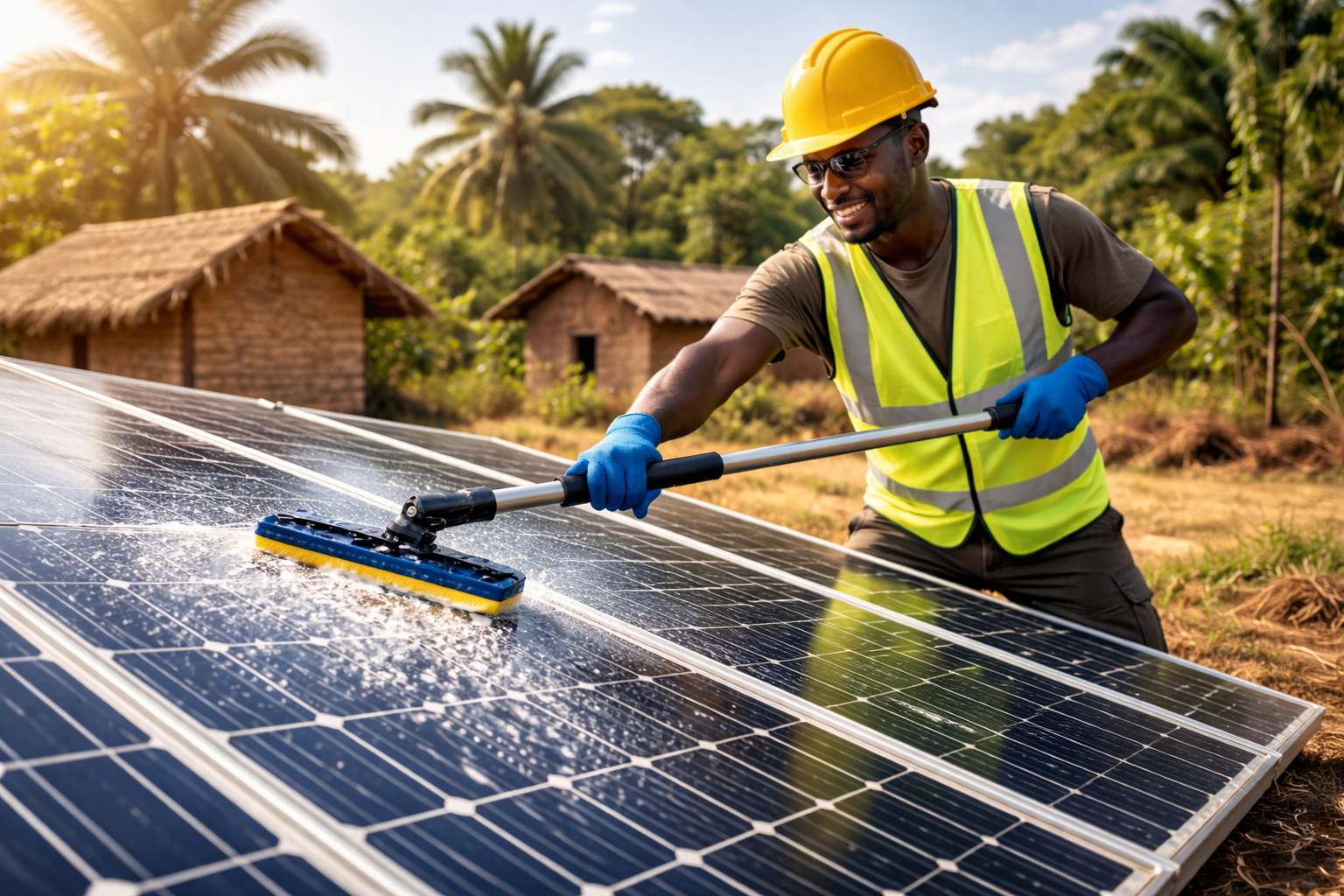
How to Clean Dust from Solar Panels in Nigeria and Africa, Step-by-Step Guide

The topic we’re looking at is ” How to Clean Dust from Solar Panels in Nigeria and Africa Step-by-Step Guide”
Solar energy is growing faster than ever across Africa. Africa’s solar panel imports set a new record in the 12 months to June 2025, reaching 15,032 MW — a 60% increase on the preceding 12 months. Nigeria alone imported about 1,721 MW of solar panels between June 2024 and June 2025, making it the second largest solar panel importer in Africa after South Africa.
But here is the problem that most solar guides ignore: a dirty panel is a wasted panel.
If you have solar panels at home or your business in Nigeria, dust is silently reducing the amount of electricity they produce every single day. This guide shows you exactly how to clean your panels safely, how often to do it, and what mistakes to avoid.
Read: Why Solar Panels Lose Efficiency (And How to Fix It Fast)
Why Dust Is a Major Problem for Solar Panels in Africa
Research has shown that dust accumulation can significantly reduce a solar panel’s power output by up to 56% over time, compared with clean panels. In Africa, this problem is especially bad because:
– Harmattan season coats surfaces with fine, dry dust for months
– Inconsistent rainfall means panels go long periods without any natural rinse
– Dusty roads and open land mean panels get dirty faster than in Europe or North America
In northern Nigerian states such as Kano, Kaduna, and Katsina, the combination of dust, traffic, farming activity, and seasonal conditions creates particularly harsh conditions for solar panels.
The result? You pay for a full solar system but only get a fraction of the power it should produce.
How Often Should You Clean Your Solar Panels?
| Season / Condition | Recommended Cleaning Frequency |
| Harmattan / Dry season | Every 1–2 weeks |
| Normal conditions | Once a month |
| Rainy season | Every 2–3 months |
Quick rule: If your battery is not charging properly and your inverter looks fine, check your panels first. Dust is the most common and most overlooked cause of poor solar performance.
Best Time of Day to Clean Solar Panels
Always clean your panels early in the morning or late in the evening. Never clean in the hot afternoon sun.
Here is why this matters:
– Hot glass + cold water = thermal shock, which can crack your panel
– Water dries too fast in direct sun, leaving behind white streaks and mineral stains
– Morning dew slightly loosens dust, making it easier to wipe away
Tools You Need (All Affordable and Locally Available)
What to use:
– Soft sponge or microfibre cloth
– Soft-bristle brush
– Clean, preferably filtered water
– Mild liquid soap (optional — for bird droppings or caked-on dirt)
What to avoid at all costs:
– Hard or abrasive brushes (they leave permanent scratches on the glass)
– Harsh chemicals like bleach, acid, or petrol-based cleaners
– Pressure washers (too forceful — they can damage the panel frame and seals)
Research shows that the method of cleaning affects solar panel efficiency, and that mild soap helps maintain panel performance by removing sticky particles that water alone cannot lift.
Step-by-Step: How to Clean Your Solar Panels
Step 1 — Switch Off Your System
Turn off your inverter before touching the panels. This is non-negotiable. It protects both you and the equipment.
Step 2 — Dry-Brush First
Use a soft dry brush to sweep off the top layer of loose dust. If you skip this and go straight to water, you turn dry dust into muddy paste that is harder to remove.
Step 3 — Wash Gently With Water
Wet your sponge or cloth and wipe across the panel surface in smooth, even strokes. Work from top to bottom. Give extra attention to bird droppings and built-up grime — these need slightly more pressure but still gentle handling.
Step 4 — Rinse Thoroughly
If you used soap, rinse it off completely. Soap residue left on panels attracts more dust and causes streaks that block light.
Step 5 — Dry and Inspect
Let the panels air-dry, or gently wipe with a clean dry cloth. Once done, do a quick visual check for cracks, loose wires, or anything unusual on the panel surface.

Rooftop Safety Rules
– Use a stable ladder that is properly secured before climbing
– Never step on the panels — the glass can crack under body weight
– Do not clean during windy or rainy conditions
– If your panels are mounted very high or on a steep roof, hire a professional to clean them
Does Rain Clean Solar Panels?
Rain gives panels a light rinse, but it is not enough on its own. Rainfall cannot remove:
– Heavy harmattan dust that has dried and compacted on the surface
– Bird droppings
– Oily or sticky particles from traffic and cooking fumes
Read: Best tools to clean solar panel
Think of rain as a gentle pre-wash, not a full clean. Manual cleaning remains necessary regardless of how much rain falls.
Read: How Much Does Solar Power Cost in Africa in 2026? (Panels, Batteries & Installation)
Pro Tips for Better Long-Term Performance
Angle your panels correctly.
Researchers have shown that optimising the tilt angle of solar panels enhances the gravitational forces that reduce dust accumulation on the panel surface. A tilt of 30–45 degrees allows dust and rainwater to slide off naturally.
Keep surroundings tidy.
Sweeping around your property and reducing exposed dry soil near your panels will cut down how fast they get dirty again.
Monitor your output regularly.
Get familiar with what your normal daily power generation looks like. If it drops without obvious reason, check your panels before assuming the system has a fault.
Clean more during harmattan.
This season demands fortnightly cleaning at a minimum to maintain output.
Common Mistakes That Cost You Power
| Mistake | Why It Hurts |
| Using dirty or muddy water | You spread more dirt, not less |
| Scrubbing hard | Scratches the glass and permanently reduces output |
| Cleaning in hot afternoon sun | Thermal shock risk + water streaks |
| Waiting until output is visibly poor | Small dust buildup compounds daily; clean proactively |
| Ignoring bird droppings | Even a small dropping creates a shadow that reduces the whole panel’s output |
A Note on Waterless Cleaning Technology
Researchers have developed an automated waterless solar panel cleaning system that uses an ejector blower for air-jet cleaning and a flexible brush for dust sweeping. In testing, the system recorded an average increase of 26.23% in power output after cleaning. These systems are not yet widely affordable across Nigeria, but they represent where the industry is heading — particularly useful in the north where water scarcity makes wet cleaning difficult.
Frequently Asked Questions (FAQ)
How much efficiency do solar panels lose from dust in Nigeria?
Studies show panels can lose between 10% and 56% of their output depending on how long dust has been allowed to accumulate and the type of dust. Harmattan dust is particularly damaging because it is fine, dry, and builds up quickly.
Can I use tap water to clean my solar panels?
Yes, but if your tap water is hard (high mineral content), it can leave white deposits after drying. Filtered or clean rainwater is ideal. Always use a soft cloth, never a rough sponge.
Is it safe to clean solar panels myself?
Yes, if your panels are safely accessible and you follow the safety rules — ladder secured, system switched off, no cleaning in wind or rain. For very high or steep installations, hire a professional.
Why is my solar battery not charging even after cleaning?
If cleaning the panels does not fix the problem, check your charge controller settings, battery health, and cable connections. A faulty charge controller or aging battery can also cause poor charging.
Should I clean both the front and back of the panel?
Only the front glass surface needs regular cleaning — that is where sunlight enters. The back of the panel does not affect output, though keeping it free of obstructions helps with heat dissipation.
Does shade from dust affect the whole panel or just part of it?
Even partial shading from dust or bird droppings can reduce the output of an entire panel, depending on how it is wired. This is called the “shading effect” and is why even a small dirty patch matters.
How do I know if my panels need cleaning right now?
If your daily power output has dropped noticeably, if you can see a visible layer of dust or grime, or if it has been more than two weeks during harmattan season — clean them today.
References and Further Reading
1. Ogunsona, S. (2025). Waterless Solar Cleaning: A Game Changer for the Solar Future of Dry Regions. Eco-Business / Giving Compass. [eco-business.com](https://www.eco-business.com/news/in-dry-regions-waterless-cleaning-could-make-solar-panels-more-efficient/)
2. Ember Energy. (2025). The First Evidence of a Take-Off in Solar in Africa. [ember-energy.org](https://ember-energy.org/latest-insights/the-first-evidence-of-a-take-off-in-solar-in-africa/)
3. Shao, Y. et al. (2025). Navigating Nigeria’s Path to Sustainable Energy: Challenges, Opportunities, and Global Insight. Energy Strategy Reviews, 59, 101707.
4. CleanTechnica. (2025, November). African Nations Promote Locally Produced Solar Panels. [cleantechnica.com](https://cleantechnica.com/2025/11/17/african-nations-promote-locally-produced-solar-panels/)
5. Chatham House. (2025, December). Nigeria is Sparking Renewable Solutions to Its Energy Crisis. [chathamhouse.org](https://www.chathamhouse.org/publications/the-world-today/2025-12/nigeria-sparking-renewable-solutions-its-energy-crisis)
6. ScienceDirect. (2022). A Brief Summary of Cleaning Operations and Their Effect on Photovoltaic Performance in Africa and the Middle East. [sciencedirect.com](https://www.sciencedirect.com/science/article/pii/S235248472200155X)
Read: Solar Panel Maintenance Tips for Long-Lasting Performance in Africa
Conclusion
I hope with this guide, many owners of solar systems would have solved the problem of low efficiency.
This article answer effortlessly the the problems:
How to clean dust from solar panels
Solar cleaning tips for dry season
How to clean solar panels at home, and best way to clean solar panels without scratching.